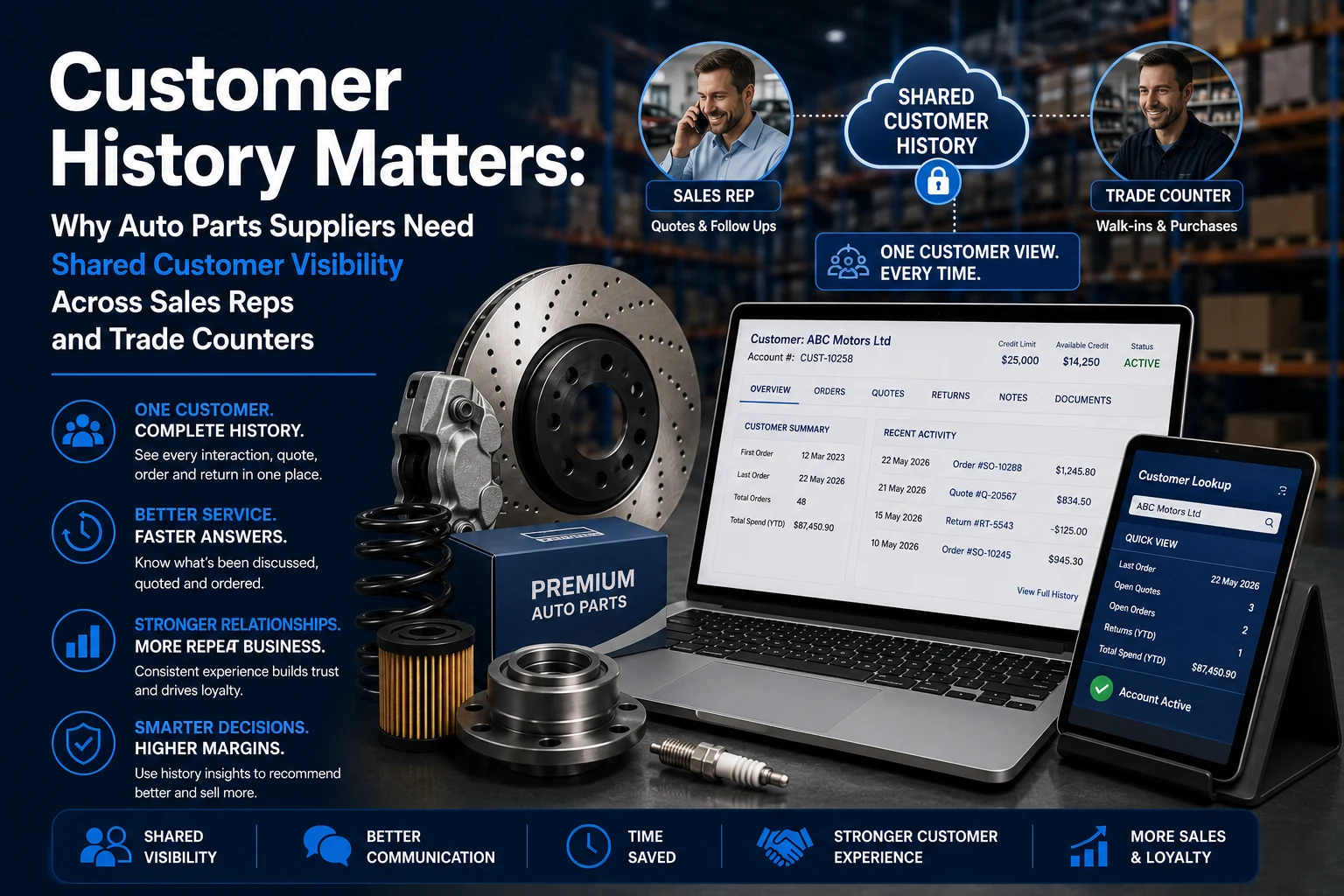
Customer History Matters: Why Auto Parts Suppliers Need Shared Customer Visibility Across Sales Reps and Trade Counters
Synopsis
When the trade counter, the reps and the office each hold a different version of a customer, the customer notices. This guide covers the cost of poor visibility, what shared customer history looks like, the role of a rep app, and how ecommerce ties it together.
Table of Contents
- 1.Introduction
- 2.The Cost of Poor Customer Visibility
- 3.Why Trade Customers Expect Better Service in 2026
- 4.Common Problems Caused by Disconnected Systems
- 5.What Shared Customer History Looks Like
- 6.The Role of Sales Rep Apps in Automotive Wholesale
- 7.How Ecommerce and Customer History Work Together
- 8.Real-World Example
- 9.Common Mistakes Auto Parts Suppliers Make
- 10.How JustSell Helps Solve This Problem
- 11.FAQs
- 12.The Future of Customer Management in Automotive Wholesale
Introduction
The automotive aftermarket has changed dramatically over the last few years.
Garages, workshops, fleet operators and repair centres now expect the same level of service from auto parts suppliers that they receive from major online retailers. They want fast answers, accurate pricing, quick order processing and consistent communication regardless of who they speak to.
Yet many auto parts wholesalers still struggle with a common problem:
A customer speaks to a field sales representative on Monday, phones the trade counter on Tuesday, and emails customer service on Wednesday. Each person has different information, different notes and different visibility into the account.
The result is frustration for both customers and staff.
As competition increases in 2026, successful auto parts suppliers are investing in shared customer visibility, centralised account history and connected sales systems to create a better buying experience while improving operational efficiency.
The Cost of Poor Customer Visibility
Most automotive wholesalers have multiple customer touchpoints:
- Field sales representatives
- Internal sales teams
- Trade counter staff
- Customer service teams
- Account managers
- Ecommerce support teams
When these teams operate in separate systems, customer information becomes fragmented.
A garage owner might receive a quote from a sales rep, then ring the trade counter to place the order.
Instead of immediately helping the customer, the trade counter team asks:
- Which parts were quoted?
- What prices were agreed?
- Which rep handled the enquiry?
- Was there a discount approved?
- Has the order already been processed?
The customer becomes frustrated because they are repeating information they have already provided.
Over time this damages trust and creates the impression that the supplier is disorganised.
Why Trade Customers Expect Better Service in 2026
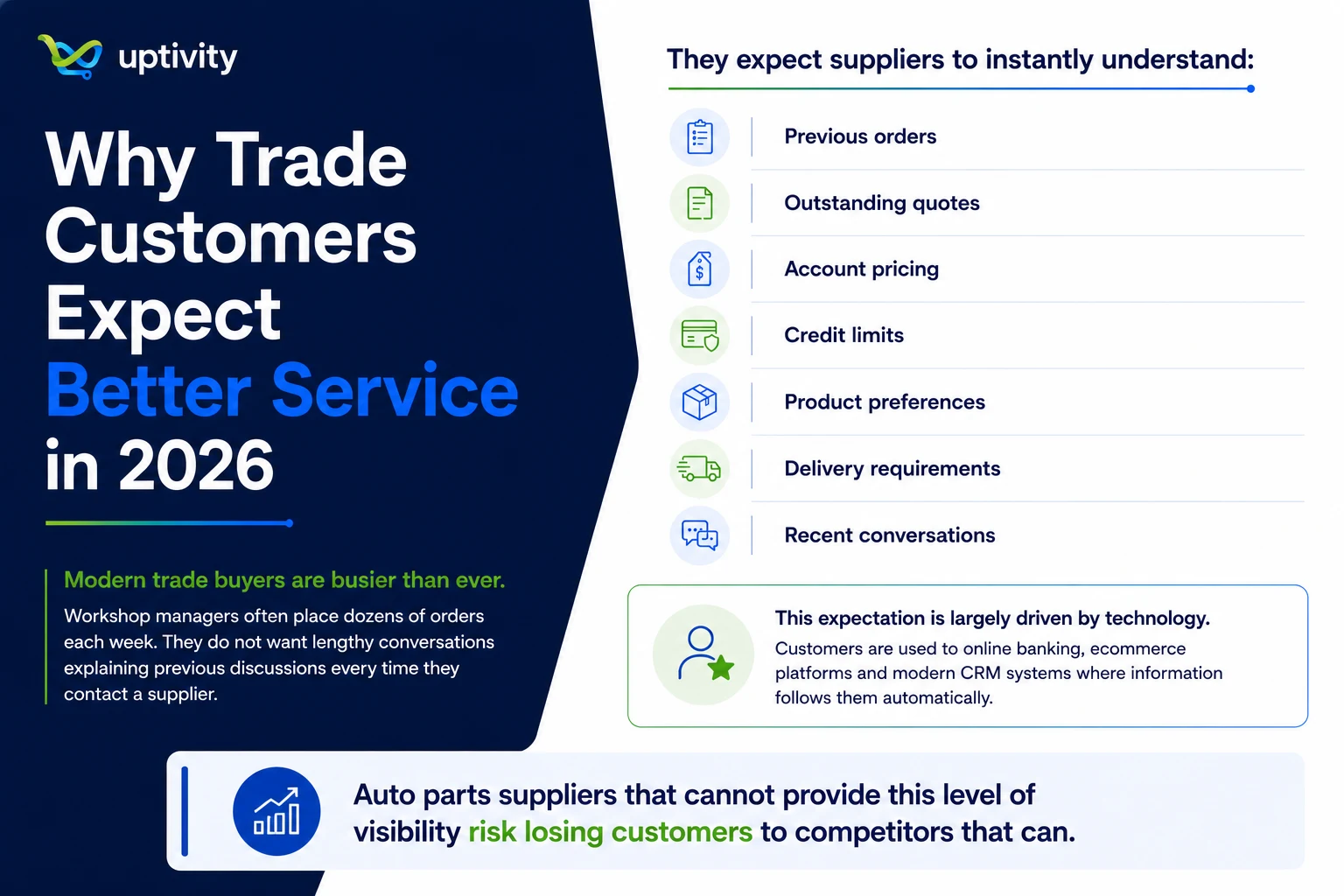
Modern trade buyers are busier than ever.
Workshop managers often place dozens of orders each week. They do not want lengthy conversations explaining previous discussions every time they contact a supplier.
They expect suppliers to instantly understand:
- Previous orders
- Outstanding quotes
- Account pricing
- Credit limits
- Product preferences
- Delivery requirements
- Recent conversations
This expectation is largely driven by technology.
Customers are used to online banking, ecommerce platforms and modern CRM systems where information follows them automatically.
Auto parts suppliers that cannot provide this level of visibility risk losing customers to competitors that can.
Common Problems Caused by Disconnected Systems
Lost Quotes
Sales reps create quotes manually and send them via email.
When customers call later, trade counter staff cannot find the original quotation.
This leads to:
- Delayed orders
- Incorrect pricing
- Duplicate quotes
- Lost sales opportunities
Pricing Disputes
Customer-specific pricing is common within automotive wholesale.
Without centralised visibility, staff may:
- Quote incorrect prices
- Apply the wrong discount levels
- Override agreed terms
- Create unnecessary margin erosion
Duplicate Work
Multiple employees often end up handling the same request.
One team creates a quote.
Another team re-enters the quote.
A third team manually processes the order.
The same information is entered repeatedly, wasting valuable time.
Poor Customer Experience
Nothing frustrates a customer more than repeating information.
The moment customers feel they must explain their account history every time they contact a supplier, confidence begins to drop.
The Role of Sales Rep Apps in Automotive Wholesale
Many suppliers still rely on sales reps carrying notebooks, spreadsheets or disconnected CRM systems.
The problem is that valuable customer information remains trapped with individual employees.
Modern sales rep applications allow representatives to:
- Create quotes on-site
- Record customer visits
- Log discussions
- Add follow-up notes
- Create orders instantly
- Access stock availability
- View account history
Most importantly, this information becomes immediately available to the wider business.
When the customer later contacts the office, everyone has access to the same information.
How Ecommerce and Customer History Work Together
Many automotive wholesalers now operate customer ordering portals and B2B ecommerce platforms.
These systems become significantly more powerful when connected to customer account history.
Customers can:
- Reorder previous purchases
- View past invoices
- Access quotes
- Check account pricing
- Track deliveries
- Review order status
This reduces pressure on internal teams while improving customer convenience.
Instead of calling the trade counter for routine enquiries, customers can often find the information themselves.
Real-World Example
Imagine a regional auto parts distributor supplying independent garages.
A sales representative visits a customer and discusses brake components, filters and suspension parts.
During the meeting they create a quotation for £3,500 worth of products.
The following morning the customer phones the trade counter.
In a disconnected business, the customer may need to explain everything again.
In a connected business, the trade counter employee immediately sees:
- The sales rep's visit notes
- The quotation created yesterday
- Customer-specific pricing
- Product availability
- Delivery options
The order can be processed within minutes.
The customer experiences a smooth and professional buying journey.
Common Mistakes Auto Parts Suppliers Make
Relying on Employee Memory
Customer relationships should not depend on staff remembering conversations.
Information must be stored centrally.
Using Multiple Systems
Separate spreadsheets, CRMs, order systems and email records create information silos.
Connected systems deliver better visibility.
Failing to Capture Customer Interactions
Every conversation contains valuable information.
Without recording these interactions, opportunities are often lost.
Not Giving Trade Counter Staff Enough Information
Trade counter teams frequently handle urgent customer requests.
Providing immediate access to customer history dramatically improves response times.
How JustSell Helps Solve This Problem
Many automotive wholesalers face customer visibility challenges because sales, customer service, ecommerce and order management operate separately.
JustSell brings these areas together through:
- A dedicated Sales Rep App
- Centralised customer account history
- Shared quote visibility
- Order tracking
- Customer-specific pricing
- Trade account management
- Ecommerce integration
- Mobile access for field sales teams
This means sales representatives, trade counter staff and customer service teams all work from the same customer information.
Instead of asking customers to repeat themselves, businesses can provide a more connected and professional experience.
FAQs
Shared customer history ensures every employee can access previous orders, quotes, pricing agreements and customer interactions. This creates a smoother experience for trade customers and reduces errors.
Information often becomes fragmented when businesses use separate systems for sales, CRM, ecommerce, quotations and customer service without integration.
Staff can instantly see previous interactions, allowing them to answer questions faster and avoid asking customers to repeat information.
A complete account history should include quotes, orders, pricing agreements, communication notes, account status, delivery information and customer preferences.
Modern sales rep apps allow notes, quotes and customer interactions to be recorded centrally and shared automatically across the business.
Yes. Better visibility helps teams identify opportunities, follow up faster and provide more personalised service to customers.
Centralised systems ensure all employees see the same agreed pricing, reducing disputes and protecting profit margins.
Connected ecommerce platforms allow customers and staff to access order history, invoices, quotes and account information from a single source.
Customers often speak to both field reps and trade counter staff. Shared visibility ensures conversations continue seamlessly regardless of who handles the enquiry.
Spreadsheets are difficult to keep updated, lack real-time visibility and often create information silos that lead to mistakes and missed opportunities.
Using a centralised platform that combines customer accounts, orders, quotes, pricing and sales activity helps ensure everyone works from the same information.
Key features include customer account history, quote management, order tracking, sales rep tools, customer-specific pricing, trade account management and ecommerce integration.
The Future of Customer Management in Automotive Wholesale
As competition continues to increase, customer experience will become a major differentiator.
Price and product availability remain important, but buyers increasingly value convenience, speed and consistency.
The most successful auto parts suppliers in 2026 will be those that remove friction from the buying process.
Shared customer history, connected sales teams and centralised account visibility help achieve exactly that.
When every employee has access to the same information, customers receive faster answers, fewer mistakes occur and stronger long-term relationships are built.
For automotive wholesalers looking to improve customer retention, increase sales efficiency and modernise operations, centralised customer visibility is no longer a luxury. It is becoming a competitive necessity.
Related Articles
How Manufacturing and Engineering Distributors Can Manage Complex Product Catalogues More Effectively
Engineering catalogues run to tens of thousands of SKUs, each with sizes, materials, ratings and certifications. This guide covers why basic ecommerce falls short, how technical product structures and filtering improve discovery, and where customer-specific catalogues help.

How Manufacturing and Engineering Distributors Can Reduce Delays Caused by Quotes and Negotiated Pricing
Manufacturing procurement runs on quotes and negotiated pricing, and every approval adds delay. This guide covers what slow quoting costs, how customer-specific pricing cuts manual enquiries, and how quote-to-order workflows let buyers purchase faster.

Managing Customer-Specific Pricing in Vape Wholesale: How to Reduce Admin and Increase Sales
When every customer has a different price list, pricing turns into admin. This guide covers the types of wholesale pricing, what manual processes cost, and how customer groups, tiers and promotions increase order values.