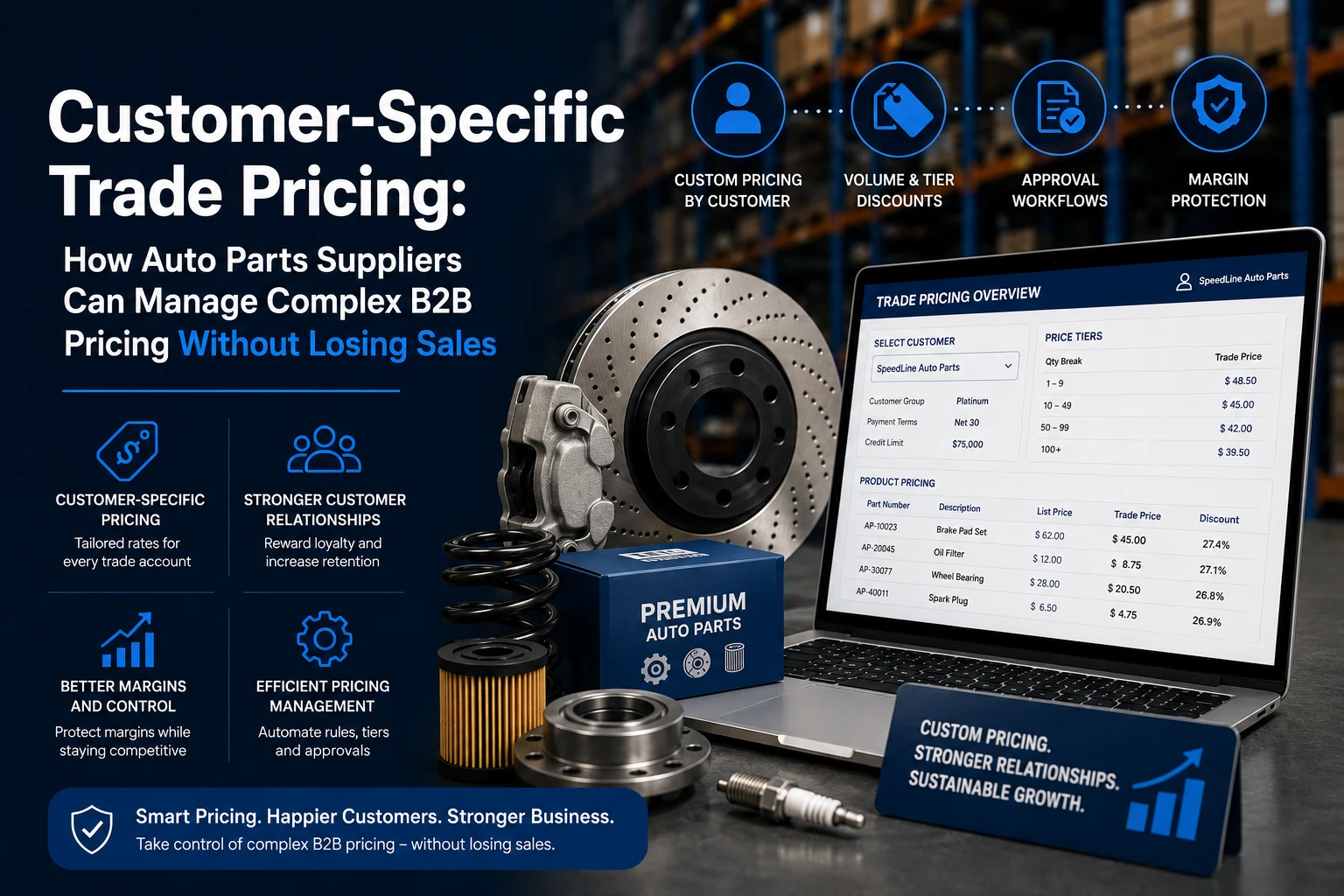
Customer-Specific Trade Pricing: How Auto Parts Suppliers Can Manage Complex B2B Pricing Without Losing Sales
Synopsis
Trade pricing in auto parts is unusually complex, and manual pricing quietly costs sales. This guide covers what modern trade customers expect, customer-specific pricing done properly, combining pricing with part search, and the mistakes wholesalers make.
Table of Contents
- 1.Introduction
- 2.Why Trade Pricing Is So Complex in the Auto Parts Industry
- 3.The Hidden Cost of Manual Pricing Management
- 4.What Modern Trade Customers Expect in 2026
- 5.Customer-Specific Pricing Done Properly
- 6.Why This Matters for Auto Parts Suppliers
- 7.Combining Pricing With Part Search
- 8.Real-World Example
- 9.Common Mistakes Automotive Wholesalers Make
- 10.How JustSell Helps Automotive Wholesalers
- 11.FAQs
- 12.Final Thoughts
Introduction
In the auto parts wholesale industry, pricing is rarely as simple as displaying one price for every customer.
A garage buying brake pads every week may receive one discount level. A national fleet operator may have a negotiated contract price. A body shop might qualify for volume discounts. Meanwhile, trade counters, retailers, workshops, and resellers often expect their own pricing structures, payment terms, and account conditions.
This creates a challenge for many automotive wholesalers.
As customer relationships grow, pricing becomes increasingly difficult to manage. What starts as a few spreadsheet-based discounts can quickly turn into a pricing nightmare that causes errors, lost margin, customer complaints, and unnecessary administration.
The suppliers winning more trade customers in 2026 are the ones that have modernised how they manage customer-specific pricing online.
Why Trade Pricing Is So Complex in the Auto Parts Industry
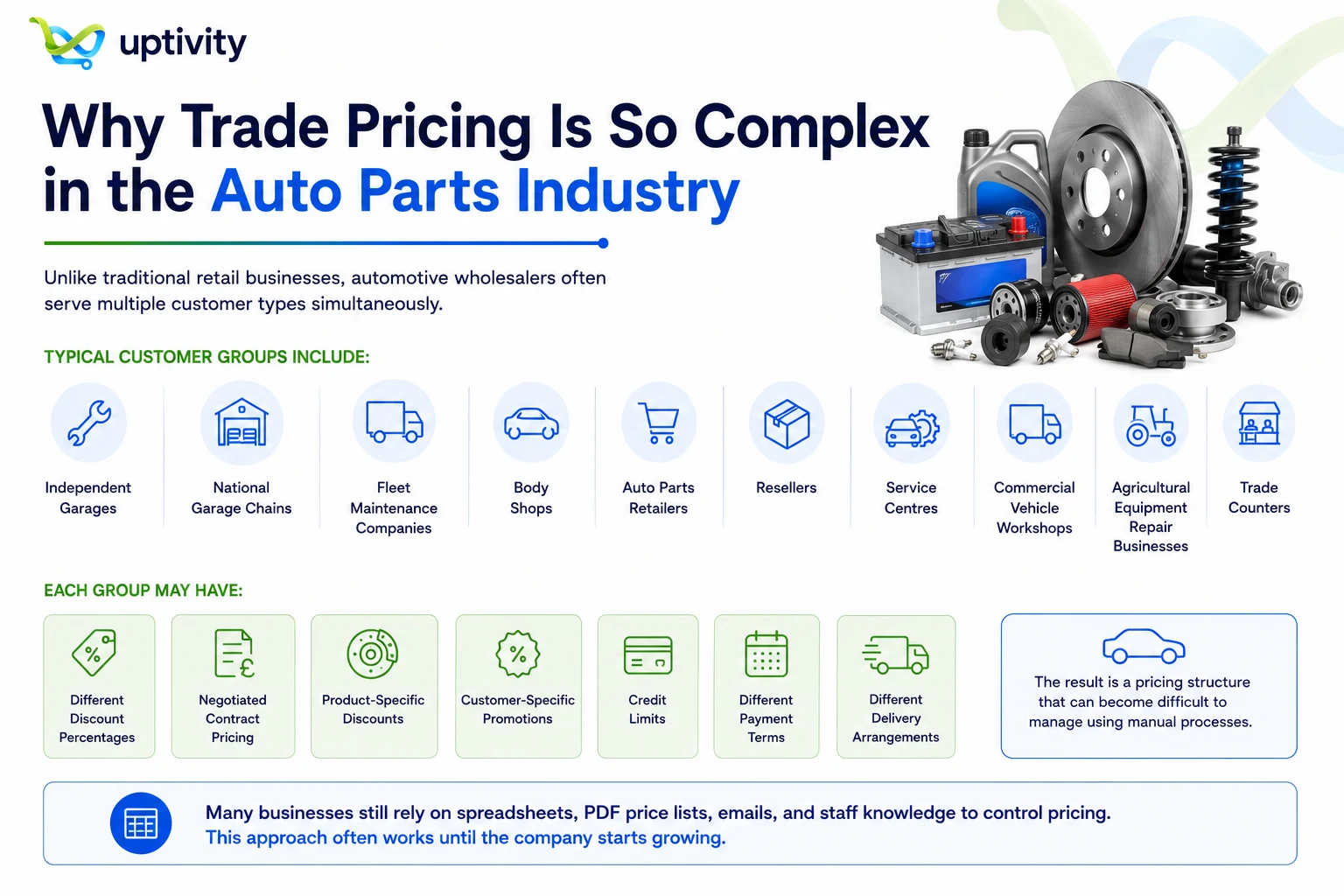
Unlike traditional retail businesses, automotive wholesalers often serve multiple customer types simultaneously.
Typical customer groups include:
- Independent garages
- National garage chains
- Fleet maintenance companies
- Body shops
- Auto parts retailers
- Resellers
- Service centres
- Commercial vehicle workshops
- Agricultural equipment repair businesses
- Trade counters
Each group may have:
- Different discount percentages
- Negotiated contract pricing
- Product-specific discounts
- Customer-specific promotions
- Credit limits
- Different payment terms
- Different delivery arrangements
The result is a pricing structure that can become difficult to manage using manual processes.
Many businesses still rely on spreadsheets, PDF price lists, emails, and staff knowledge to control pricing.
This approach often works until the company starts growing.
What Modern Trade Customers Expect in 2026
Automotive buyers have changed.
The next generation of trade buyers expects the same convenience they experience elsewhere online.
They want to:
- Log into their account
- See their negotiated pricing instantly
- View available stock
- Place repeat orders
- Access invoices
- Download statements
- Reorder previous purchases
Without needing to call someone first.
The businesses delivering this experience are often winning orders away from competitors that still rely on manual processes.
Customer-Specific Pricing Done Properly
Modern B2B ecommerce systems allow wholesalers to automate customer-specific pricing.
Instead of maintaining dozens of spreadsheets, businesses can create pricing rules that automatically apply when customers log in.
Account-Specific Pricing
Some customers negotiate bespoke pricing.
The system recognises the customer account and displays their agreed rates.
Product-Level Discounts
Specific customers can receive discounts on selected product ranges while paying standard pricing elsewhere.
This is particularly useful for:
- Brake components
- Engine parts
- Oils and lubricants
- Commercial vehicle parts
- Seasonal products
Volume-Based Pricing
Customers receive better pricing as order quantities increase.
This encourages larger basket sizes while protecting margins.
Why This Matters for Auto Parts Suppliers
The automotive sector has one of the most competitive wholesale markets.
Price transparency has increased dramatically.
Customers can compare suppliers faster than ever.
Winning today is not simply about being cheapest.
It's about making buying easier.
If a garage can log in, find the correct part, view their negotiated pricing, and place an order within minutes, they are far more likely to remain loyal.
Convenience becomes a competitive advantage.
Combining Pricing With Part Search
Pricing is only one part of the challenge.
Auto parts buyers rarely search like normal ecommerce customers.
They often search using:
- Registration numbers
- Vehicle make and model
- Year
- Engine type
- OE numbers
- Part numbers
- Cross-reference numbers
- Brand compatibility
The most successful wholesalers combine intelligent product search with personalised pricing.
Customers quickly find the correct part and immediately see the correct trade price.
This significantly improves conversion rates.
Real-World Example
Consider two automotive wholesalers.
Supplier A
- Uses PDF price lists
- Relies on email quotations
- Customers must phone for account pricing
- Sales staff manually check discounts
Supplier B
- Provides customer logins
- Displays personalised pricing automatically
- Allows online ordering 24/7
- Shows stock availability instantly
- Supports repeat ordering
Which supplier is likely to win more business?
Increasingly, the answer is Supplier B.
Trade customers value speed, convenience, and accuracy.
Common Mistakes Automotive Wholesalers Make
Treating B2B Like Retail Ecommerce
Most retail ecommerce platforms were never designed for complex trade pricing.
They struggle with customer-specific pricing structures.
Maintaining Too Many Spreadsheets
Spreadsheets eventually become impossible to manage accurately.
As customer numbers grow, errors become inevitable.
Hiding Pricing Behind Phone Calls
Many wholesalers still require customers to call for pricing.
This creates friction and slows down purchasing decisions.
Ignoring Mobile Ordering
Workshop managers, fleet buyers, and technicians increasingly place orders from mobile devices.
Pricing and ordering systems must work seamlessly across all devices.
How JustSell Helps Automotive Wholesalers
Many automotive wholesalers face these challenges because traditional ecommerce platforms were built primarily for retail sales.
JustSell was designed with wholesale and trade ordering in mind.
Features such as:
- Customer-specific pricing
- Customer groups
- Trade account management
- Account-based ordering
- Volume discounts
- Repeat ordering
- Customer ordering apps
- Sales representative tools
- Wholesale-focused ecommerce
allow suppliers to manage complex pricing structures without creating additional administrative work.
The result is a smoother experience for both customers and internal teams.
FAQs
Customer-specific pricing allows different customers to see different prices based on negotiated agreements, customer groups, discount structures, or contract terms.
Different customer types often receive different discounts and payment terms. Personalised pricing helps manage these arrangements accurately and consistently.
Yes. Modern B2B ecommerce platforms can automatically display customer-specific pricing when customers log into their accounts.
Retail pricing is generally fixed for all customers. Trade pricing varies depending on customer agreements, purchase volumes, and account status.
Volume discounts automatically reduce prices when customers purchase larger quantities of products, encouraging bigger orders.
Yes. Customers appreciate easy access to their negotiated prices and often remain more loyal to suppliers that make ordering simple.
Customer groups allow wholesalers to assign pricing, discounts, and permissions to specific categories of customers such as garages, fleets, or retailers.
Automating pricing rules through a B2B ecommerce platform significantly reduces manual mistakes and ensures consistent pricing.
It can be when handled manually. Modern wholesale ecommerce systems automate the process and make pricing management much easier.
Yes. JustSell supports customer-specific pricing, customer groups, trade accounts, discounts, and account-based ordering workflows designed for wholesale businesses.
Key features include customer-specific pricing, trade accounts, stock visibility, repeat ordering, part search capabilities, mobile ordering, and sales representative support.
Final Thoughts
Managing customer-specific trade pricing has become a critical requirement for automotive wholesalers.
As competition increases and customer expectations continue to evolve, businesses that rely on spreadsheets, manual quotations, and outdated pricing processes risk falling behind.
The suppliers winning more trade customers in 2026 are making it easier to buy.
They provide personalized pricing, self-service ordering, better visibility, and a faster customer experience.
For automotive wholesalers looking to grow without increasing administration, modern trade ecommerce systems are becoming less of a competitive advantage and more of a necessity.
Related Articles
How Manufacturing and Engineering Distributors Can Manage Complex Product Catalogues More Effectively
Engineering catalogues run to tens of thousands of SKUs, each with sizes, materials, ratings and certifications. This guide covers why basic ecommerce falls short, how technical product structures and filtering improve discovery, and where customer-specific catalogues help.

How Manufacturing and Engineering Distributors Can Reduce Delays Caused by Quotes and Negotiated Pricing
Manufacturing procurement runs on quotes and negotiated pricing, and every approval adds delay. This guide covers what slow quoting costs, how customer-specific pricing cuts manual enquiries, and how quote-to-order workflows let buyers purchase faster.

Managing Customer-Specific Pricing in Vape Wholesale: How to Reduce Admin and Increase Sales
When every customer has a different price list, pricing turns into admin. This guide covers the types of wholesale pricing, what manual processes cost, and how customer groups, tiers and promotions increase order values.