
Too Many Prices to Remember? Why Construction Wholesalers Need a Smarter B2B Ecommerce Platform
Synopsis
Customer-specific pricing is the part of wholesale that spreadsheets handle worst. This guide explains what a B2B ecommerce platform does for a wholesaler, why it matters now, the challenges it addresses and the benefits of putting pricing under one system.
Table of Contents
Introduction
Retail price. Trade price. Contractor price. Special price. Bulk discount. Customer-specific discount.
For many wholesalers, that’s the daily reality. Your sales team, trade counter staff, and customer service team are expected to remember who gets what price, which discount applies, and whether the customer has a negotiated rate for a certain product line.
That might work when you’ve got a small number of customers and a simple product list. But once the business grows, manual pricing quickly becomes risky.
A B2B ecommerce platform for wholesaler businesses helps take that pressure off your team. Instead of staff checking spreadsheets, old invoices, printed price lists, or someone’s memory, customers can log in and see the prices, discounts, stock, and ordering options that apply to them.
That matters because B2B buyers now expect a much smoother digital buying experience. Gartner’s 2026 research found that 67% of B2B buyers prefer a rep-free experience, showing how important self-service buying has become. (Gartner)
What Is a B2B Ecommerce Platform for Wholesaler Businesses?
A B2B ecommerce platform for wholesaler businesses is an online ordering system designed for trade customers, distributors, merchants, and suppliers.
Unlike a standard online shop, it needs to handle the messy bits of wholesale selling, such as:
- rade pricing
- Contractor pricing
- Special pricing
- Customer-specific discounts
- Wholesale price lists
- Bulk discount pricing
- Repeat order ecommerce
- Account-based product visibility
- Credit account workflows
- Quotes, invoices, and order history
- Stock availability
- Delivery or collection options
In normal B2C ecommerce, most customers see the same price. In wholesale, that’s rarely the case.
One customer might pay the standard trade price. Another might have a better rate because they buy in volume. A contractor might have agreed pricing on certain product groups. A long-term customer might have a special price on specific SKUs.
That’s why wholesale ecommerce software needs to do more than display products. It needs to show the right customer the right price at the right time.
Why a B2B Ecommerce Platform for Wholesaler Businesses Matters in Modern Business
Wholesale buyers are changing. They still value relationships, but they don’t always want to phone or email for every repeat order.
If they already know what they need, they want to log in, check their price, see availability, and order quickly. DHL’s 2025 B2B ecommerce report highlights that business buyers now expect the same speed, convenience, and transparency they’re used to as consumers. (DHL)
That doesn’t mean your sales team becomes less important.
It means your sales team stops being dragged into basic admin every day.
Instead of answering “What’s my price on this?” or “Can I order the same as last time?”, they can focus on better conversations: finding new opportunities, helping customers buy the right products, and winning more business.
For wholesalers, the biggest value is often in reducing friction.
Less friction means:
- Fewer pricing disputes
- Fewer order corrections
- Fewer missed discounts
- Fewer slow repeat orders
- Fewer calls for basic order updates
- Better visibility across sales, stock, and customers
This is where a wholesale customer portal becomes especially useful. Uptivity’s JustSell wholesale ecommerce solution includes customer portal access, order history, invoices, order status updates, documents, and resources, helping reduce paperwork, unnecessary calls, and manual invoices. (Uptivity UK)
Key Challenges Businesses Face
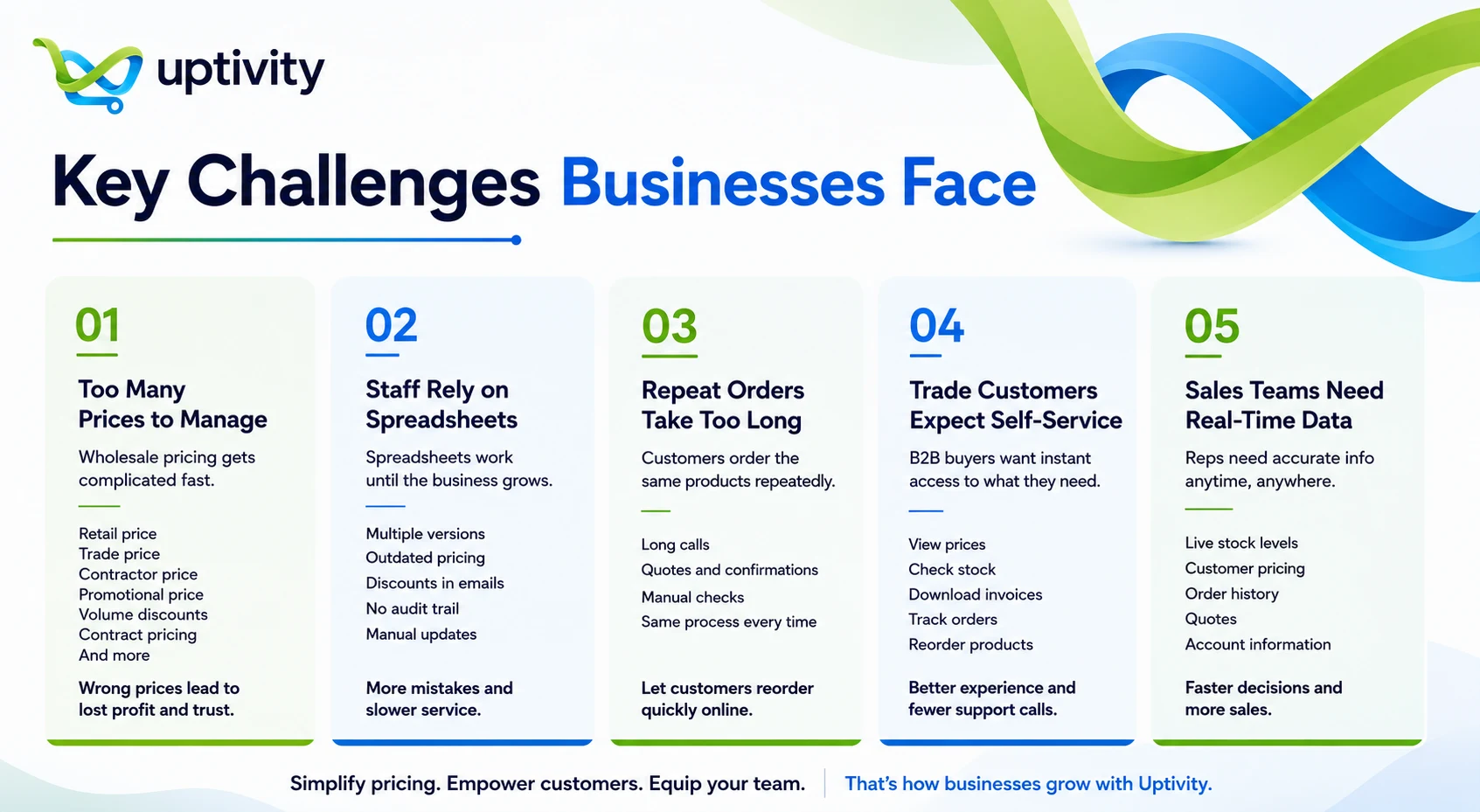
1. Too many prices to remember
Wholesale pricing gets complicated fast.
You might have:
- Retail price
- Trade price
- Contractor price
- Special price
- Promotional price
- Volume-based discount
- Customer-specific discount
- Product-category discount
- Contract pricing
When this is managed manually, mistakes are almost guaranteed.
A staff member might quote an old price. A new team member might apply the wrong discount. A customer might get charged more than agreed, damaging trust. Or they might get charged too little, quietly eating into margin.
That’s revenue leakage.
It might not look dramatic on one order, but across hundreds or thousands of orders, it adds up.
2. Staff depend on spreadsheets and memory
Spreadsheets can work for a while. But as the business grows, they become harder to trust.
Common problems include:
- Different staff using different versions
- Price changes not being updated everywhere
- Discounts being stored in emails or notes
- No clear audit trail
- No automatic link between customer, product, and price
This slows people down and creates avoidable pressure.
3. Repeat orders take longer than they should
Many wholesale customers order the same products again and again.
If they have to phone, wait for a quote, ask for pricing, confirm availability, and then repeat the same process next week, everyone loses time.
A better repeat order ecommerce setup lets customers reorder from order history, favourites, previous invoices, or saved lists.
4. Trade customers expect better self-service
A self-service customer portal gives customers more control. They can check information without waiting for your team to reply.
That matters because B2B buyers are increasingly comfortable with digital purchasing. Gartner’s 2025 buyer research found that 61% preferred an overall rep-free buying experience, while 73% actively avoided suppliers sending irrelevant outreach. (Gartner)
The message is clear: buyers want useful digital access, not unnecessary chasing.
5. Sales teams lack real-time information
If sales reps don’t have live pricing, stock, order history, and customer information, they’re working with one hand tied behind their back.
Uptivity’s Sales Rep App supports real-time stock levels, quote generation, customer purchase history, and overdue payment management from a mobile device. (Uptivity UK)
That’s useful for field sales, internal sales, trade counter teams, and account managers who need accurate information while speaking to customers.
Benefits of Implementing a B2B Ecommerce Platform
Fewer pricing mistakes
The clearest benefit is accuracy.
When pricing rules are managed properly, customers see the correct price based on their account, discount level, contract, or volume.
This helps reduce:
- Wholesale pricing errors
- Manual discount mistakes
- Margin loss
- Customer complaints
- Time spent correcting invoices
Faster repeat orders
A good wholesale ordering system makes repeat buying easier.
Customers can log in, find what they bought before, check their price, and place the order without needing to call.
For busy trade customers, this is a big win. They don’t want to waste time repeating the same order details every week.
Less pressure on internal teams
Your team still matters, but they shouldn’t have to act as a human price-checking system.
A B2B customer portal can reduce common admin questions around:
- Prices
- Discounts
- Order history
- Invoices
- Documents
- Delivery updates
- Product availability
That gives sales and customer service staff more time to help with higher-value work.
Better customer experience
Customers trust suppliers who make ordering easy.
If they can see their correct trade price, check stock, place an order, and track progress, they’re less likely to shop around.
A smooth customer experience doesn’t just improve satisfaction. It protects repeat revenue.
Better visibility for management
A connected ecommerce for distributors setup gives managers better insight into:
- What customers are buying
- Which products are moving
- Which customers are inactive
- Where discounts are being used
- Which sales reps are driving revenue
- Where order mistakes are happening
This helps leaders make better decisions instead of relying on guesswork.
Improved margin control
Bad pricing control quietly damages profit.
If the wrong discount is applied, or if old pricing is honoured by mistake, your margin takes the hit.
A customer-specific pricing software setup helps protect profit by making agreed pricing visible and consistent.
FAQ Section
It’s an online ordering platform designed for wholesalers, distributors, merchants, and trade suppliers. It lets trade customers log in, see their correct prices, place orders, view order history, access invoices, and reorder products without needing to contact the sales team every time.
It connects customers, products, pricing, discounts, orders, and account information. When a trade customer logs in, the system shows the pricing and ordering options linked to their account, such as trade pricing, contractor pricing, special pricing, or customer-specific discounts.
It helps reduce manual work, pricing mistakes, slow repeat orders, and customer frustration. It also gives customers a more convenient way to buy, which matters as more B2B buyers expect self-service digital options. Gartner’s 2026 research found that 67% of B2B buyers prefer a rep-free experience. (Gartner)
A B2B customer portal can give customers access to order history, invoices, documents, pricing, discounts, order status updates, and repeat ordering. This reduces admin for your team and gives customers more control.
Avoid choosing a basic online shop that can’t handle complex pricing rules. Also avoid launching with messy data, ignoring sales team training, or failing to connect ecommerce with stock, customer, and order information.
Choose a platform that supports customer-specific pricing, wholesale price lists, repeat orders, quote workflows, order history, customer portals, mobile access, and integration with your wider operations. The right choice should match how your business actually sells
Conclusion
Uptivity’s JustSell is built around the practical problems wholesalers face every day: complex pricing, repeat orders, trade customer ordering, sales team visibility, and customer self-service.
The JustSell wholesale ecommerce page highlights personalised pricing, customer portal access, sales management, order history, invoices, documents, order status updates, and reduced paperwork. (Uptivity UK)
That fits the core problem this article is about: staff shouldn’t have to remember every price for every customer.
With the right setup, a wholesaler can give customers access to their correct prices and ordering information while giving the internal team better control.
JustSell also connects naturally with other operational needs. For example, Uptivity’s Delivity app helps businesses manage drivers, routes, delivery sequencing, real-time driver tracking, ETA updates, and missed delivery reduction. (Uptivity UK)
That matters because ecommerce doesn’t stop when the order is placed. Customers also care about when the order arrives, whether the stock is right, and whether they can trust the supplier to deliver.
The biggest benefit is not simply “having software”.
The real benefit is having fewer gaps between sales, pricing, stock, customers, and delivery.
When those gaps close, the business becomes easier to manage.
You get:
- Fewer order mistakes
- Faster repeat orders
- Better pricing control
- Less admin
- Better visibility
- More confident customers
- More time for sales teams to sell
That’s where software becomes a proper business tool rather than another system to maintain.
Wholesale pricing is too important to leave to memory.
When your team is juggling retail price, trade price, contractor price, special price, customer-specific discounts, and bulk discount pricing, mistakes become expensive.
A B2B ecommerce platform for wholesaler businesses helps bring pricing, ordering, customer accounts, and repeat buying into one clearer process.
The result is simple: customers can order faster, your team spends less time fixing errors, and the business protects more margin.
For wholesalers, distributors, merchants, and trade suppliers, this is no longer just a “nice to have”. It’s becoming part of how modern B2B customers expect to buy.
Related Articles
How Manufacturing and Engineering Distributors Can Manage Complex Product Catalogues More Effectively
Engineering catalogues run to tens of thousands of SKUs, each with sizes, materials, ratings and certifications. This guide covers why basic ecommerce falls short, how technical product structures and filtering improve discovery, and where customer-specific catalogues help.

How Manufacturing and Engineering Distributors Can Reduce Delays Caused by Quotes and Negotiated Pricing
Manufacturing procurement runs on quotes and negotiated pricing, and every approval adds delay. This guide covers what slow quoting costs, how customer-specific pricing cuts manual enquiries, and how quote-to-order workflows let buyers purchase faster.

Managing Customer-Specific Pricing in Vape Wholesale: How to Reduce Admin and Increase Sales
When every customer has a different price list, pricing turns into admin. This guide covers the types of wholesale pricing, what manual processes cost, and how customer groups, tiers and promotions increase order values.