
B2B Wholesale Ecommerce: How do Current Construction Suppliers have such Modernised Trade Ordering?
Synopsis
Phone, email and spreadsheets still carry most trade orders, and the cost shows as a business grows. This guide covers what B2B wholesale ecommerce is, the challenges it removes, how to implement it, the mistakes to avoid, and where the market is heading.
Table of Contents
- 1.Introduction
- 2.What Is B2B Wholesale Ecommerce?
- 3.https://www.youtube.com/shorts/2ju-aTiNpvI
- 4.Why B2B Wholesale Ecommerce Matters in Modern Business
- 5.Key Challenges Businesses Face
- 6.Benefits of Implementing B2B Wholesale Ecommerce
- 7.How to Successfully Implement B2B Wholesale Ecommerce
- 8.Common Mistakes to Avoid
- 9.Future Trends and Industry Developments
- 10.How Uptivity Helps Businesses Solve These Challenges
- 11.FAQ
- 12.Conclusion
Introduction
For many wholesalers, distributors, manufacturers, and builders merchants, order processing still relies heavily on phone calls, emails, spreadsheets, and manual data entry. While these methods may have worked in the past, they often create costly inefficiencies as businesses grow.
B2B wholesale ecommerce provides a modern alternative. By allowing trade customers to place orders through an online portal, businesses can reduce order entry errors, improve customer service, and streamline internal operations.
As customer expectations continue to evolve, wholesalers that invest in digital ordering systems gain a significant competitive advantage through greater efficiency, improved accuracy, and stronger customer relationships.
- What Is B2B Wholesale Ecommerce?
- Why B2B Wholesale Ecommerce Matters
- Key Challenges Businesses Face
- Benefits of Implementing B2B Wholesale Ecommerce
- How to Successfully Implement a Solution
- Common Mistakes to Avoid
- Future Trends
- How Uptivity Helps
- FAQ
What Is B2B Wholesale Ecommerce?
B2B wholesale ecommerce refers to online systems that allow businesses to sell products directly to trade customers through a digital ordering platform.
Unlike consumer ecommerce, B2B platforms are designed for:
- Customer-specific pricing
- Trade accounts
- Bulk ordering
- Repeat orders
- Credit facilities
- Contract pricing
- Complex product catalogues
A modern wholesale customer portal enables customers to browse products, check stock availability, place orders, and access account information without contacting sales teams directly.
https://www.youtube.com/shorts/2ju-aTiNpvI
Why B2B Wholesale Ecommerce Matters in Modern Business
The wholesale sector is undergoing rapid digital transformation.
Customers increasingly expect the same convenience they experience in consumer ecommerce. They want to:
- Place orders at any time
- View live stock levels
- Access pricing instantly
- Reorder products quickly
- Track orders online
Businesses that fail to provide these capabilities risk losing customers to competitors that offer faster and more convenient ordering experiences.
Beyond customer expectations, digital ordering platforms help businesses eliminate operational bottlenecks that limit growth.
Key Challenges Businesses Face
Phone Order Mistakes
Phone-based ordering remains common across many wholesale sectors.
Unfortunately, verbal communication creates opportunities for:
- Incorrect product codes
- Quantity errors
- Pricing misunderstandings
- Delivery mistakes
Even minor errors can result in customer dissatisfaction, returns, and lost revenue.
Manual Order Entry
When staff manually enter orders from emails or phone conversations, valuable time is spent on administration rather than revenue-generating activities.
This often creates:
- Delays
- Duplicate work
- Human error
- Increased labour costs
Inventory Visibility Issues
Without integrated systems, customers may order products that are unavailable.
This can lead to:
- Backorders
- Delivery delays
- Customer frustration
- Reduced trust
Difficulty Scaling
As order volumes increase, manual processes become increasingly difficult to manage.
Businesses often find themselves hiring additional administrative staff simply to maintain existing service levels.
Benefits of Implementing B2B Wholesale Ecommerce
Improved Order Accuracy
Customers enter their own orders directly into the system, significantly reducing opportunities for human error.
Accurate orders mean:
- Fewer disputes
- Lower returns
- Better customer satisfaction
Increased Efficiency
Sales and customer service teams spend less time processing routine orders and more time focusing on strategic customer relationships.
Self-Service Ordering
Trade customers can place orders whenever convenient.
This removes dependency on office opening hours and creates a better buying experience.
Better Inventory Accuracy
Integrated systems provide real-time stock visibility, helping customers make informed purchasing decisions.
Faster Repeat Ordering
Many B2B customers purchase the same products repeatedly.
A digital platform makes reordering simple through:
- Saved order history
- Favourite products
- Quick reorder functionality
Improved Customer Retention
Convenience often becomes a competitive advantage.
When ordering is easy, customers are less likely to switch suppliers.
How to Successfully Implement B2B Wholesale Ecommerce
Step 1: Understand Customer Requirements
Speak with customers to understand:
- How they currently place orders
- Common frustrations
- Desired features
Customer feedback should shape platform requirements.
Step 2: Audit Existing Processes
Review current workflows and identify:
- Manual tasks
- Bottlenecks
- Data duplication
- Error-prone processes
Understanding these pain points helps prioritise improvements.
Step 3: Integrate Business Systems
The most successful implementations connect ecommerce with:
- Inventory management
- Warehouse management
- CRM systems
- Accounting software
Integrated systems eliminate duplicate data entry and improve operational visibility.
Step 4: Train Staff and Customers
Technology adoption is critical.
Provide:
- User guides
- Demonstrations
- Ongoing support
This helps maximise platform utilisation.
Step 5: Measure Performance
Track key metrics such as:
- Order accuracy
- Order processing time
- Customer adoption rates
- Customer satisfaction
- Administrative costs
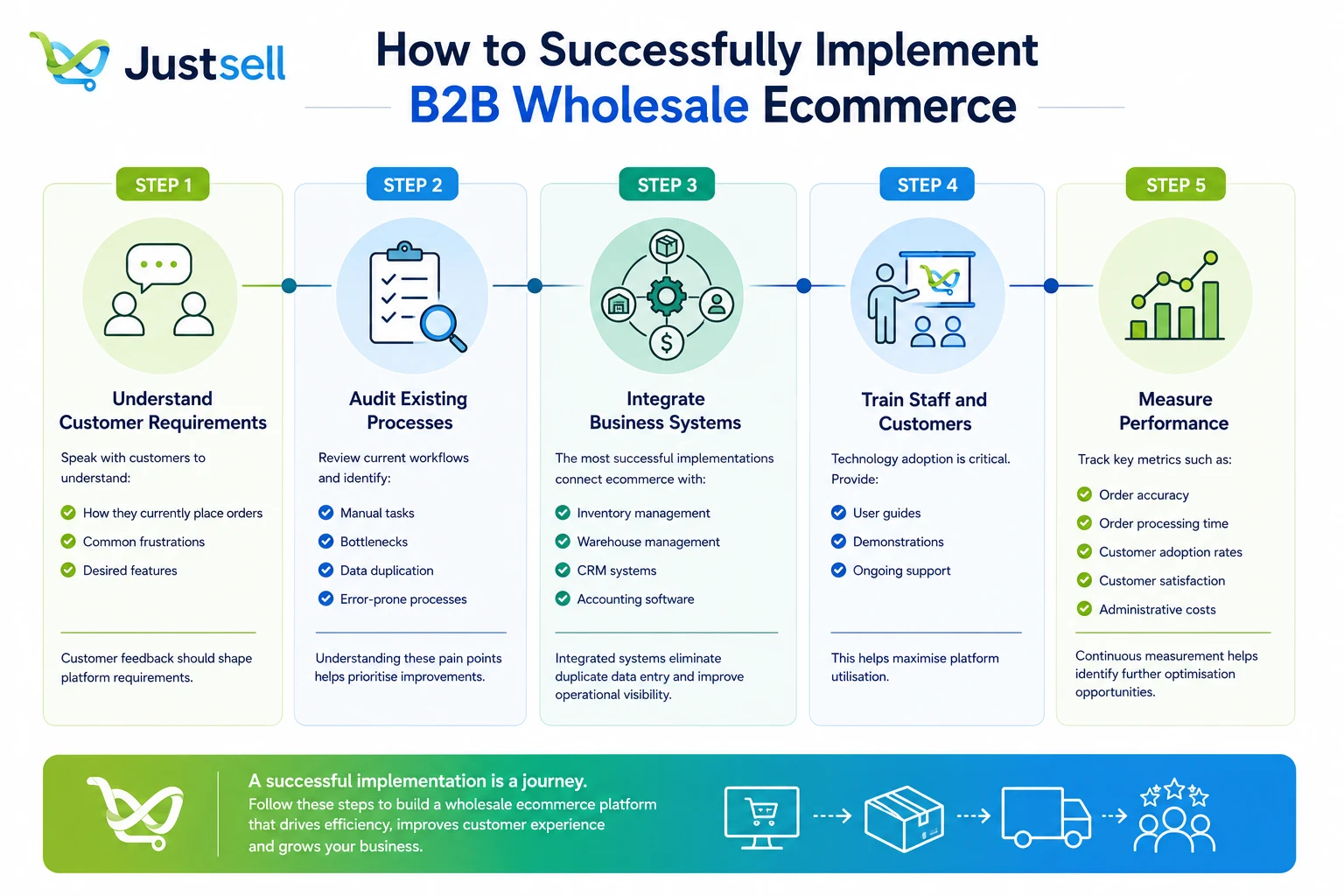
Continuous measurement helps identify further optimisation opportunities.
Common Mistakes to Avoid
Treating Ecommerce as a Standalone Project
The greatest benefits come when ecommerce forms part of a broader digital transformation strategy.
Ignoring Customer Experience
A platform that works for internal teams but frustrates customers will struggle to achieve adoption.
Failing to Integrate Systems
Disconnected systems often create new problems rather than solving existing ones.
Overcomplicating the Ordering Process
Customers value simplicity.
Complex ordering journeys can reduce usage and satisfaction.
Future Trends and Industry Developments
Several trends are shaping the future of wholesale ecommerce.
Greater Automation
Businesses are increasingly automating:
- Order processing
- Inventory updates
- Customer communications
Mobile Ordering
Customers expect access from smartphones and tablets.
Mobile-friendly platforms are becoming essential.
Real-Time Data Visibility
Live inventory, pricing, and delivery information are becoming standard expectations.
AI-Powered Recommendations
Intelligent systems can help customers discover relevant products and improve purchasing decisions.
How Uptivity Helps Businesses Solve These Challenges
Modern wholesale businesses require more than just an online storefront.
They need connected systems that improve visibility, efficiency, and operational performance across the entire organisation.
Uptivity's cloud-based software ecosystem supports digital transformation through integrated solutions covering:
- Ecommerce
- Inventory management
- Warehouse management
- Delivery operations
- Facilities management
- Compliance management
- Operational productivity
By connecting critical business processes, organisations can reduce manual administration, improve order accuracy, increase visibility, and create a more scalable operating model.
Rather than simply digitising orders, businesses can create a connected environment where information flows seamlessly across departments, helping teams make faster and better-informed decisions.
FAQ
B2B wholesale ecommerce is an online platform that allows trade customers to purchase products digitally through a self-service ordering system.
Customers log into a secure portal, view products, access pricing, check stock levels, and place orders online. Orders are then processed through integrated business systems.
It improves efficiency, reduces order errors, enhances customer experience, and supports business growth.
Benefits include improved order accuracy, self-service ordering, reduced administration, faster repeat purchases, and better customer retention.
Common mistakes include poor system integration, ignoring customer experience, overcomplicating workflows, and treating ecommerce as a standalone initiative.
Look for platforms that integrate with existing systems, support customer-specific pricing, provide inventory visibility, and offer scalability for future growth.
Conclusion
B2B wholesale ecommerce has evolved from a competitive advantage into a business necessity.
Companies that continue relying on manual ordering processes face increasing challenges around efficiency, accuracy, scalability, and customer expectations.
By implementing a modern wholesale ordering platform and integrating it with wider business systems, organisations can reduce errors, improve customer satisfaction, and position themselves for sustainable growth.
For businesses looking to modernise operations, now is the ideal time to evaluate how digital ordering and automation can support long-term success.
Related Articles
How Manufacturing and Engineering Distributors Can Manage Complex Product Catalogues More Effectively
Engineering catalogues run to tens of thousands of SKUs, each with sizes, materials, ratings and certifications. This guide covers why basic ecommerce falls short, how technical product structures and filtering improve discovery, and where customer-specific catalogues help.

How Manufacturing and Engineering Distributors Can Reduce Delays Caused by Quotes and Negotiated Pricing
Manufacturing procurement runs on quotes and negotiated pricing, and every approval adds delay. This guide covers what slow quoting costs, how customer-specific pricing cuts manual enquiries, and how quote-to-order workflows let buyers purchase faster.

Managing Customer-Specific Pricing in Vape Wholesale: How to Reduce Admin and Increase Sales
When every customer has a different price list, pricing turns into admin. This guide covers the types of wholesale pricing, what manual processes cost, and how customer groups, tiers and promotions increase order values.