
B2B Ecommerce Platform: The Key to Faster Sales and Happier Customers for Construction Suppliers
Synopsis
Why B2B buying changed, how a B2B ecommerce platform works, and what distributors gain from one. Covers the benefits, the challenges and how to overcome them, implementation best practice, and the trends shaping the next few years.
Table of Contents
- 1.Introduction
- 2.What Is a B2B Ecommerce Platform?
- 3.Why B2B Buying Has Changed
- 4.How a B2B Ecommerce Platform Works
- 5.Key Benefits for Distributors and Suppliers
- 6.Common Challenges and How to Overcome Them
- 7.Best Practices for Implementation
- 8.Common Mistakes to Avoid
- 9.Future Trends in B2B Ecommerce
- 10.Frequently Asked Questions
- 11.Conclusion
Introduction
If your sales team spends hours responding to quote requests, processing orders manually, and answering stock availability questions, you're not alone.
Many wholesalers, distributors, builders merchants, manufacturers, and trade suppliers still rely on phone calls, emails, and spreadsheets to manage customer orders. While these methods may have worked in the past, today's buyers expect the same speed and convenience they experience in consumer ecommerce.
A modern B2B ecommerce platform gives customers instant access to pricing, stock levels, account information, and online ordering capabilities. The result is faster sales cycles, improved customer satisfaction, and greater operational efficiency.
In this guide, you'll learn what a B2B ecommerce platform is, why it matters, how it works, and what to look for when choosing a solution for your business.
What Is a B2B Ecommerce Platform?
A B2B ecommerce platform is an online system that allows businesses to sell products and services directly to other businesses through a digital ordering experience.
Unlike consumer ecommerce websites, B2B platforms support:
- Trade account ordering
- Customer-specific pricing
- Volume discounts
- Online quote requests
- Credit account management
- Bulk ordering
- Real-time stock visibility
- Account-specific catalogues
Many businesses also provide a dedicated B2B customer portal where customers can manage orders, invoices, statements, and delivery information without contacting customer service.
Why B2B Buying Has Changed
Business buyers increasingly expect self-service experiences.
According to Gartner research, many B2B buyers now prefer digital interactions throughout large portions of the purchasing process. Buyers want information immediately rather than waiting hours or days for responses.
When customers cannot obtain:
- Instant trade pricing
- Stock availability
- Product specifications
- Delivery information
they often look elsewhere.
Every delayed quote request creates an opportunity for a competitor to win the sale.
How a B2B Ecommerce Platform Works
A modern platform acts as a digital ordering system that connects customers directly with your inventory, pricing, and operational data.
Customer Login
Customers access a secure wholesale customer portal using their trade account credentials.
Product Search and Ordering
Buyers browse products, view contract pricing, check availability, and place orders online.
Real-Time Information
Integrated systems provide:
- Real-time stock visibility
- Customer-specific pricing
- Delivery updates
- Account balances
- Purchase history
Automated Processing
Orders flow directly into business systems, reducing manual administration and supporting faster order processing.
Key Benefits for Distributors and Suppliers
Reduce Quote Request Delays
Customers can access pricing information instantly rather than waiting for sales representatives to respond.
This shortens sales cycles and improves customer experience.
Increase Sales Capacity
A self-service ordering environment allows customers to place orders at any time.
Your sales team can focus on high-value opportunities instead of routine transactions.
Improve Order Accuracy
Manual order entry introduces mistakes.
Digital ordering reduces errors caused by phone calls, emails, and handwritten notes.
Enhance Customer Experience
Customers gain access to a convenient customer ordering portal that provides transparency and control.
Support B2B Sales Automation
Routine processes such as pricing, order processing, stock checks, and account management can be automated.
Drive Digital Transformation
A B2B ecommerce platform is often a critical component of broader B2B digital transformation initiatives.
Common Challenges and How to Overcome Them
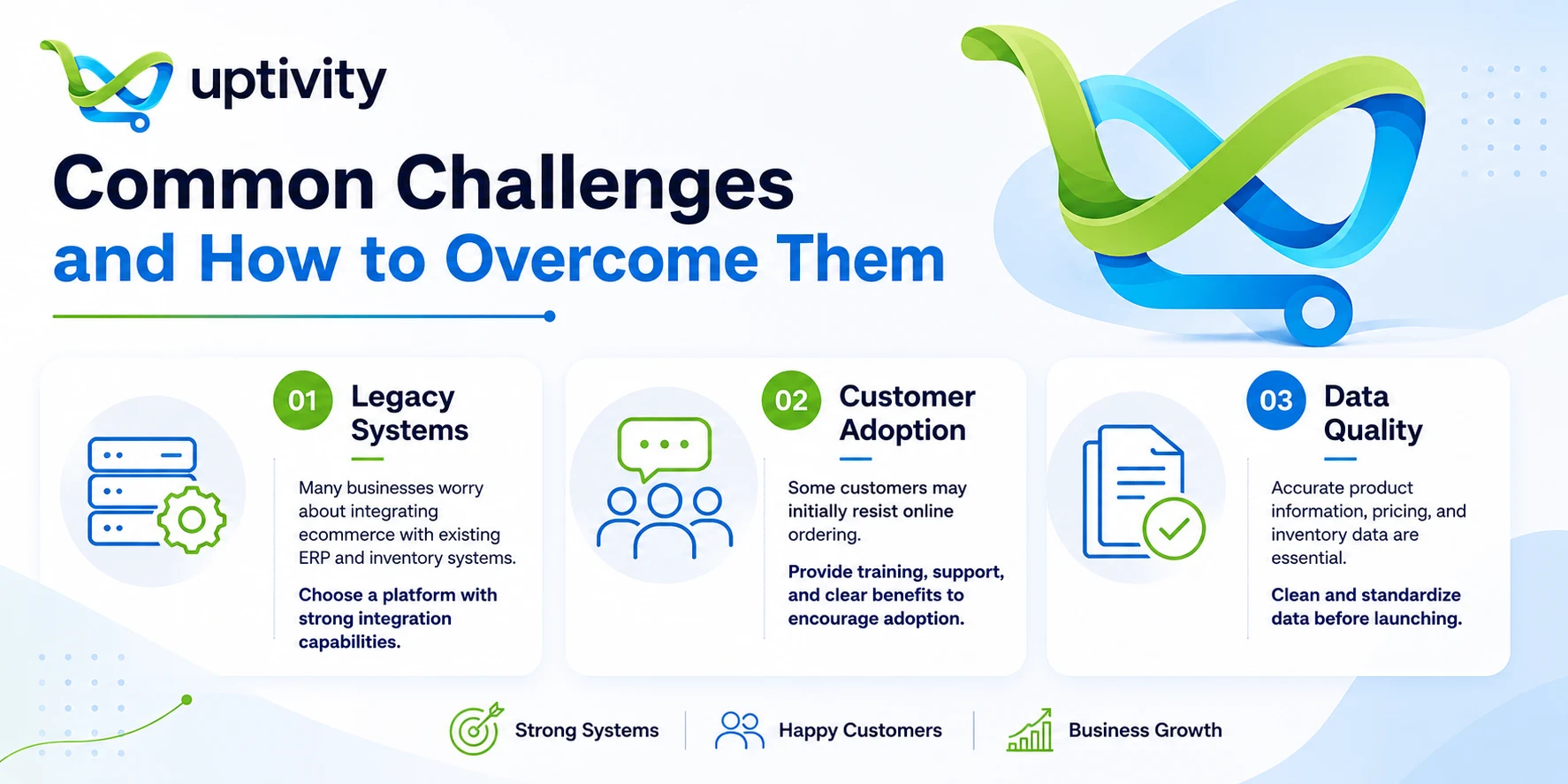
Legacy Systems
Many businesses worry about integrating ecommerce with existing ERP and inventory systems.
Choosing a platform with strong integration capabilities reduces implementation complexity.
Customer Adoption
Some customers may initially resist online ordering.
Providing training, support, and clear benefits encourages adoption.
Data Quality
Accurate product information, pricing, and inventory data are essential.
Businesses should clean and standardize data before launching.
Best Practices for Implementation
Prioritize User Experience
Ordering should be simple, intuitive, and mobile-friendly.
Integrate Core Systems
Connect your ecommerce platform with:
- ERP software
- Inventory management
- CRM systems
- Delivery management solutions
Offer Customer-Specific Pricing
Trade customers expect personalized pricing and product access.
Monitor Performance
Track:
- Online order volume
- Customer adoption rates
- Conversion rates
- Average order value
- Customer satisfaction
Common Mistakes to Avoid
Treating B2B Like B2C
Business buyers have unique requirements that consumer-focused platforms often fail to support.
Ignoring Mobile Users
Many customers place orders from warehouses, job sites, and vehicles.
Failing to Automate Processes
Without automation, businesses simply move inefficiencies online.
Not Providing Real-Time Data
Outdated pricing and stock information quickly erode trust.
Future Trends in B2B Ecommerce
Several trends are shaping the future of distributor ecommerce:
AI-Powered Recommendations
Systems increasingly recommend products based on purchasing history and buying patterns.
Greater Self-Service Capabilities
Customers expect more control over accounts, orders, invoices, and support requests.
Deeper System Integration
Businesses are connecting ecommerce platforms with every aspect of operations.
Data-Driven Decision Making
Advanced analytics help businesses identify sales opportunities and improve profitability.
Frequently Asked Questions
A B2B ecommerce platform enables businesses to sell products and services online to other businesses through digital ordering and account management tools.
A customer portal provides self-service access to pricing, orders, invoices, stock levels, and account information, reducing administrative workload.
Yes. Most modern platforms integrate with ERP, CRM, inventory management, and accounting systems.
Wholesale distributors, builders merchants, manufacturers, industrial suppliers, trade suppliers, and construction suppliers often see significant benefits.
Customers receive immediate access to information and can place orders whenever convenient without relying on office hours.
Real-time stock visibility allows customers to view current inventory levels before placing orders.
Yes. Automation reduces manual administration, order errors, and customer service workload.
Conclusion
A modern B2B ecommerce platform is no longer a competitive advantage-it is becoming a business necessity.
Customers expect instant trade pricing, online wholesale ordering, self-service account management, and real-time stock visibility. Businesses that continue relying on manual processes often experience slower sales cycles, higher operational costs, and missed revenue opportunities.
The most successful distributors, manufacturers, and trade suppliers are investing in digital ordering systems that streamline operations, improve customer experience, and support long-term growth.
Uptivity helps businesses achieve these goals through integrated cloud-based software that connects ecommerce, inventory management, operations, customer service, delivery management, and business automation into a single platform. By eliminating silos and automating critical processes, businesses can improve productivity, increase sales, and deliver the digital experience today's customers expect.
Related Articles
How Manufacturing and Engineering Distributors Can Manage Complex Product Catalogues More Effectively
Engineering catalogues run to tens of thousands of SKUs, each with sizes, materials, ratings and certifications. This guide covers why basic ecommerce falls short, how technical product structures and filtering improve discovery, and where customer-specific catalogues help.

How Manufacturing and Engineering Distributors Can Reduce Delays Caused by Quotes and Negotiated Pricing
Manufacturing procurement runs on quotes and negotiated pricing, and every approval adds delay. This guide covers what slow quoting costs, how customer-specific pricing cuts manual enquiries, and how quote-to-order workflows let buyers purchase faster.

Managing Customer-Specific Pricing in Vape Wholesale: How to Reduce Admin and Increase Sales
When every customer has a different price list, pricing turns into admin. This guide covers the types of wholesale pricing, what manual processes cost, and how customer groups, tiers and promotions increase order values.