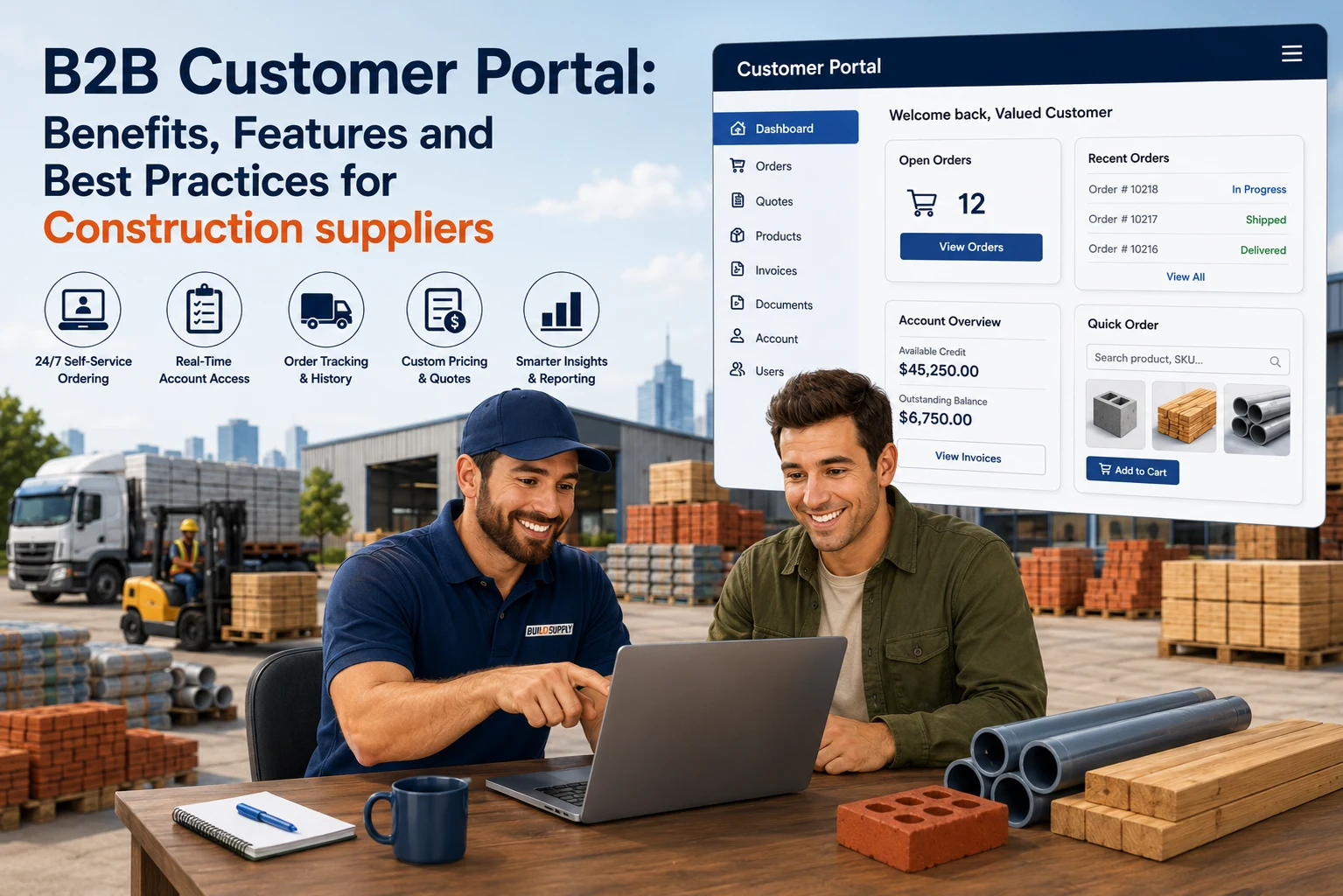
B2B Customer Portal: Benefits, Features and Best Practices for Construction suppliers
Synopsis
Customer service teams lose their day to routine questions about orders, invoices and stock. This guide sets out what a B2B customer portal is, the benefits it delivers, how to implement one without the usual mistakes, and what to measure once it is live.
Table of Contents
Introduction
For many wholesale distributors, manufacturers, and B2B suppliers, customer service teams spend a significant portion of their day answering routine questions about orders, invoices, stock availability, and account details.
While these interactions are necessary, they often create bottlenecks that slow down both customers and internal teams.
A B2B customer portal solves this problem by giving customers direct access to the information and tools they need through a self-service platform. Instead of emailing or calling for updates, customers can log in, place orders, track deliveries, view invoices, and manage their accounts whenever it suits them.
As B2B wholesale ecommerce continues to evolve, customer expectations are increasingly shaped by the convenience of consumer shopping experiences. Businesses that fail to provide digital self-service options risk falling behind competitors that offer faster and more efficient ways to do business.
What Is a B2B Customer Portal?
A B2B customer portal is a secure online account area designed specifically for business customers.
Unlike a traditional website, a customer portal provides personalised access to account-specific information and services. Depending on the platform, customers may be able to:
- Place wholesale orders online
- View pricing and product catalogues
- Access order history
- Download invoices and statements
- Track deliveries
- Reorder products quickly
- Update account information
- Submit support requests
Modern portals often form part of a larger B2B ecommerce platform, integrating with inventory management, warehouse management, accounting systems, and customer relationship management software.
The result is a more connected and efficient customer experience.
Why B2B Customer Portals Matter
The traditional wholesale sales process relies heavily on manual communication. Customers call account managers to place orders, request invoices, check stock levels, or ask for delivery updates.
As businesses grow, this approach becomes increasingly difficult to manage.
A customer self-service portal helps businesses scale without proportionally increasing administrative costs.
Research consistently shows that business buyers prefer self-service options for routine transactions. They want immediate access to information rather than waiting for responses during office hours.
For suppliers and distributors, this shift creates several advantages:
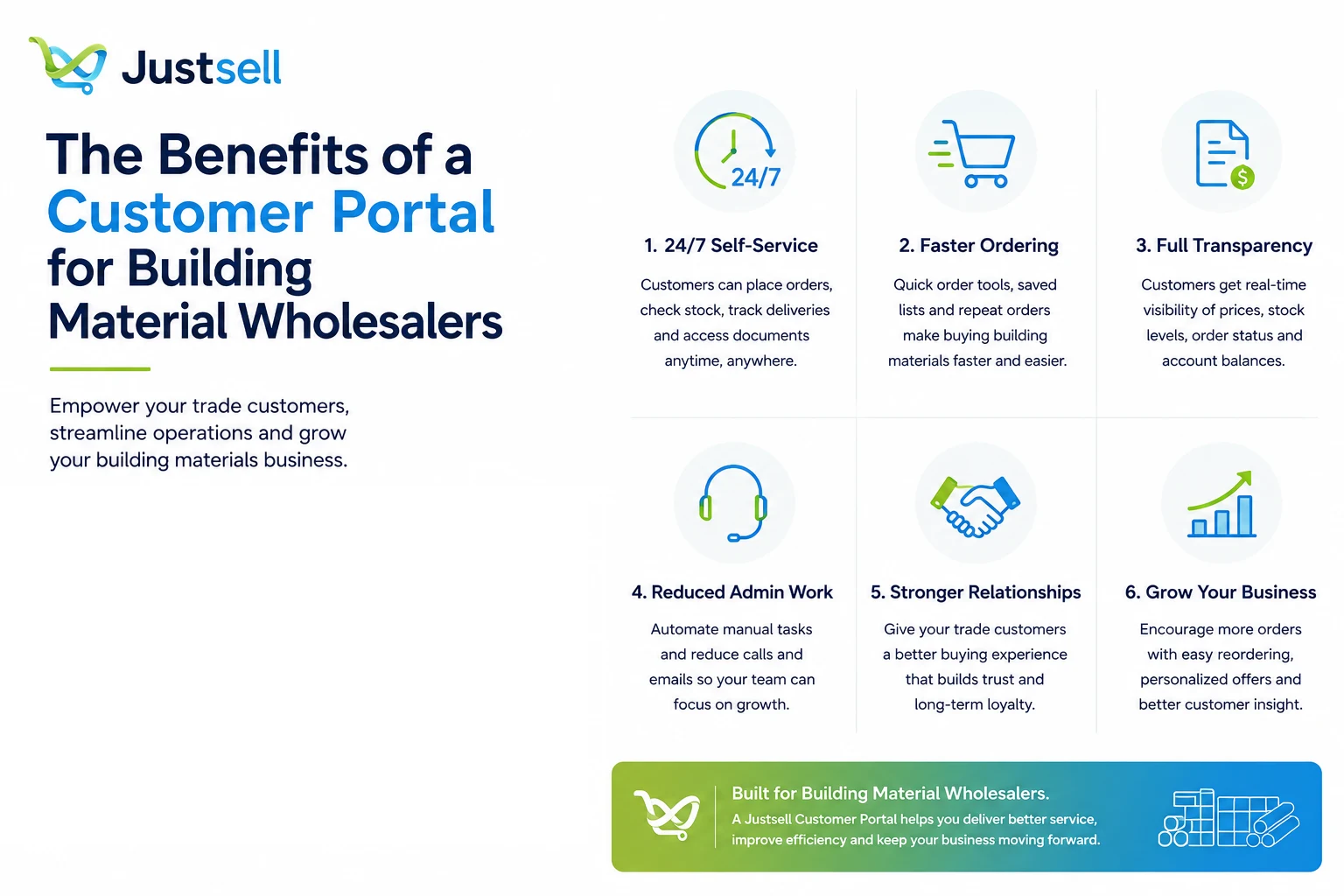
- Reduced customer service workload
- Faster order processing
- Improved customer satisfaction
- Fewer manual errors
- Better visibility across operations
- Increased sales opportunities
Perhaps most importantly, it enables businesses to provide a modern buying experience that matches evolving customer expectations.
Key Benefits of a B2B Customer Portal
Improved Customer Experience
Customers gain access to information whenever they need it. Whether checking an invoice at midnight or placing a repeat order early in the morning, they are no longer restricted by business hours.
This convenience significantly improves the wholesale customer experience.
Faster Repeat Orders
Many wholesale purchases are recurring.
A B2B order history portal allows customers to quickly reorder previously purchased products instead of manually rebuilding orders each time.
This reduces friction and can increase order frequency.
Reduced Administrative Costs
Customer service teams often spend hours handling repetitive requests.
Providing online invoice access, order tracking, and account management tools allows staff to focus on higher-value activities rather than administrative tasks.
Greater Accuracy
Manual order processing increases the risk of mistakes.
A digital wholesale platform enables customers to enter orders directly, reducing errors caused by emails, phone calls, or handwritten forms.
Better Operational Visibility
Integrated systems provide real-time visibility into inventory, orders, deliveries, and customer accounts.
This helps both customers and internal teams make better decisions.
How to Successfully Implement a B2B Customer Portal
Successful implementation requires more than simply launching new software.
1. Understand Customer Requirements
Speak directly with customers to identify their biggest frustrations.
Common requests include:
- Online ordering
- Invoice access
- Delivery tracking
- Account management
- Faster support
Prioritise features that deliver immediate value.
2. Integrate Business Systems
The most effective portals connect with existing business software.
Integration with ecommerce, inventory management, warehouse management, and accounting systems ensures customers receive accurate, real-time information.
3. Focus on User Experience
A complicated portal can create as many problems as it solves.
Navigation should be intuitive, mobile-friendly, and designed around customer workflows.
4. Automate Routine Processes
Automation is where many businesses achieve the greatest return on investment.
Automated order confirmations, invoice generation, stock updates, and account notifications help eliminate unnecessary manual work.
5. Monitor Performance
Track key metrics such as:
- Portal adoption rates
- Customer satisfaction
- Order processing times
- Support ticket volumes
- Repeat order frequency
Continuous improvement ensures the portal continues delivering value.
Common Mistakes to Avoid
Many businesses invest in customer portal software but fail to maximise results.
Common mistakes include:
- Launching without customer input
- Poor system integration
- Overcomplicated user interfaces
- Lack of staff training
- Failing to promote portal adoption
- Treating the portal as a standalone tool rather than part of a broader digital transformation strategy
Avoiding these issues significantly increases the likelihood of success.
How Uptivity Helps Businesses Improve Customer Self-Service
A customer portal delivers the greatest value when it forms part of a connected business ecosystem.
Many wholesale businesses struggle with disconnected systems, manual processes, and limited visibility across operations. These challenges often create inefficiencies that affect customer satisfaction, staff productivity, and profitability.
Uptivity's cloud-based software solutions help businesses streamline ecommerce operations, inventory management, warehouse processes, delivery operations, and customer interactions through integrated digital systems.
By connecting operational data across departments, businesses can provide customers with faster access to information while improving internal efficiency and reducing administrative workload.
Rather than relying on multiple disconnected tools, organisations gain greater visibility, automation, and scalability as they grow.
FAQ
A B2B customer portal is a secure online platform that allows business customers to place orders, access invoices, view account information, track deliveries, and manage their relationship with suppliers.
A customer portal connects with business systems such as ecommerce, inventory, and accounting software to provide customers with real-time access to account-specific information.
It reduces manual administration, improves customer satisfaction, increases operational efficiency, and enables customers to self-serve 24/7.
Key benefits include faster ordering, online invoice access, improved customer experience, lower support costs, and better operational visibility.
Look for strong integrations, ease of use, scalability, automation capabilities, security features, and support for your existing business processes.
Conclusion
A B2B customer portal has evolved from a competitive advantage into a business necessity.
Modern buyers expect self-service access to orders, invoices, account information, and support. Businesses that continue relying on manual processes risk creating frustration for customers while increasing operational costs internally.
By implementing a well-designed customer self-service portal integrated with core business systems, organisations can improve customer experience, automate routine tasks, increase efficiency, and support long-term growth.
For wholesale distributors, manufacturers, and B2B suppliers looking to modernise operations, investing in customer self-service capabilities is one of the most effective steps towards digital transformation.
Related Articles

How Manufacturing and Engineering Distributors Can Manage Complex Product Catalogues More Effectively
Engineering catalogues run to tens of thousands of SKUs, each with sizes, materials, ratings and certifications. This guide covers why basic ecommerce falls short, how technical product structures and filtering improve discovery, and where customer-specific catalogues help.

How Manufacturing and Engineering Distributors Can Reduce Delays Caused by Quotes and Negotiated Pricing
Manufacturing procurement runs on quotes and negotiated pricing, and every approval adds delay. This guide covers what slow quoting costs, how customer-specific pricing cuts manual enquiries, and how quote-to-order workflows let buyers purchase faster.

Managing Customer-Specific Pricing in Vape Wholesale: How to Reduce Admin and Increase Sales
When every customer has a different price list, pricing turns into admin. This guide covers the types of wholesale pricing, what manual processes cost, and how customer groups, tiers and promotions increase order values.