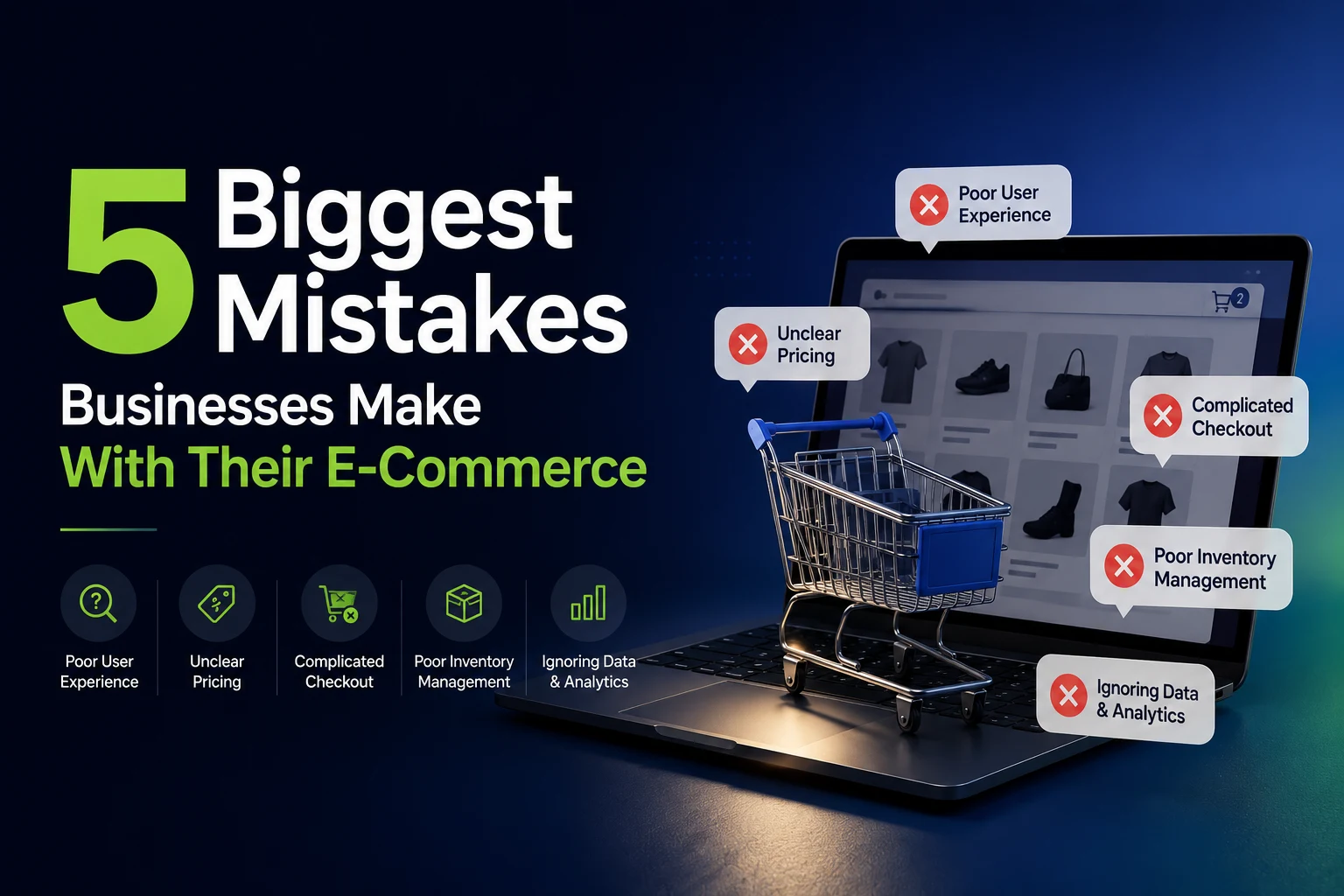
5 Biggest Mistakes Businesses Make With Their E-Commerce.
Synopsis
Five mistakes that cost ecommerce businesses more than any design decision: a platform that cannot grow, weak inventory management, ignoring B2B buyers, under-investing in SEO, and running systems that do not talk to each other.
Table of Contents
- 1.Introduction
- 2.1. Choosing an Ecommerce Platform That Cannot Grow With the Business
- 3.2. Poor Ecommerce Inventory Management
- 4.3. Ignoring The Needs Of B2B Customers
- 5.4. Failing To Invest In Ecommerce SEO And Marketing
- 6.5. Running Multiple Systems That Do Not Communicate
- 7.How JustSell Helps
- 8.Conclusion
- 9.Frequently Asked Questions
Introduction
Launching an online store has never been easier. Growing one profitably is a different challenge altogether.
Many businesses invest significant time and money into their ecommerce website only to discover that sales remain inconsistent, stock becomes difficult to manage, customers abandon purchases, and operational costs continue to rise.
Whether you're a retailer, wholesaler, manufacturer, distributor or startup founder, avoiding common mistakes can dramatically improve your chances of success. This is especially true in the world of E-commerce B2B, where customer expectations, ordering processes and operational complexity are often much greater than in traditional consumer ecommerce.
In this guide, we'll explore the five biggest mistakes businesses make with ecommerce, why they happen, and what practical steps you can take to avoid them. We'll also look at how modern ecommerce software can help simplify operations and support long-term growth.
1. Choosing an Ecommerce Platform That Cannot Grow With the Business
One of the most expensive mistakes businesses make is selecting an ecommerce platform based solely on initial cost or basic functionality.
Many businesses start with a simple website solution that appears affordable but quickly discover limitations when they begin scaling.
Common problems include:
- Poor inventory control
- Limited B2B ecommerce functionality
- Difficult integrations
- Inability to support wholesale pricing
- Lack of automation
- Restricted reporting capabilities
As businesses grow, customer expectations increase. The platform that worked for 20 orders per week may struggle with 500.
What To Consider When Choosing Ecommerce Software
When evaluating the best ecommerce platform, businesses should consider:
- Current business needs
- Future growth plans
- Multi-channel selling requirements
- B2B ordering capabilities
- Inventory management requirements
- Integration options
- Scalability
A platform should support growth rather than create barriers to it.
Practical Example
A wholesaler selling to trade customers may initially process orders through email and spreadsheets. As order volumes increase, staff spend more time managing administration than generating revenue.
A dedicated B2B ordering platform can automate much of this process while improving the customer experience.
2. Poor Ecommerce Inventory Management
Inventory issues remain one of the biggest causes of lost sales and unhappy customers.
Research consistently shows that stock availability significantly influences customer purchasing decisions. If customers cannot trust stock information, they are unlikely to return.
Poor ecommerce inventory management often results in:
- Overselling products
- Stock shortages
- Excess inventory
- Delayed fulfilment
- Lost revenue
- Poor customer reviews
Why Inventory Visibility Matters
Many businesses still rely on disconnected systems:
- Separate stock spreadsheets
- Standalone EPoS systems
- Multiple online marketplaces
- Manual stock adjustments
This creates data inaccuracies and increases administrative workload.
Best Practices For Inventory Management
Businesses should aim for:
Centralised Stock Control
All sales channels should update stock levels automatically.
Real-Time Inventory Updates
Accurate stock information reduces overselling and improves customer confidence.
Automated Reordering Processes
Forecasting and alerts help prevent stock shortages.
Better Reporting
Understanding fast-moving and slow-moving products allows better purchasing decisions.
Practical Example
A retailer selling through their website, marketplace accounts and physical store needs stock levels synchronised across every channel. Without centralised inventory management software, overselling becomes almost inevitable.
3. Ignoring The Needs Of B2B Customers
Many businesses treat B2B ecommerce exactly the same as consumer ecommerce.
This is a major mistake.
Business buyers often have completely different requirements compared to retail consumers.
What B2B Customers Expect
A successful E-commerce B2B solution should support:
- Customer-specific pricing
- Trade discounts
- Bulk ordering
- Account management
- Repeat ordering
- Credit account facilities
- Quick ordering processes
Business buyers are focused on efficiency.
If ordering takes too long or requires unnecessary steps, customers may choose competitors instead.
Common B2B Ecommerce Mistakes
Hiding Trade Pricing
Customers want quick access to agreed pricing structures.
Complicated Ordering Processes
Many trade customers know exactly what they want to purchase.
The fewer clicks required, the better.
Lack Of Customer Self-Service
Modern buyers expect access to:
- Order history
- Invoices
- Account information
- Product availability
Practical Example
A distributor selling to hundreds of trade customers can significantly reduce administration by providing an online wholesale ordering system rather than relying on phone and email orders.
4. Failing To Invest In Ecommerce SEO And Marketing
Building an ecommerce website does not guarantee visitors.
One of the most common misconceptions is that launching a website automatically generates sales.
Without visibility, even the best online store will struggle.
Why Ecommerce SEO Matters
Search engines remain one of the most valuable sources of long-term traffic.
Effective ecommerce SEO helps businesses:
- Increase visibility
- Generate organic traffic
- Reduce advertising costs
- Build authority
- Improve conversion opportunities
Key Ecommerce SEO Fundamentals
Optimised Product Pages
Every product page should include:
- Unique descriptions
- Relevant keywords
- Clear images
- Useful information
Category Page Optimisation
Category pages often generate significant search traffic.
Technical SEO
A fast, mobile-friendly website is essential.
Structured Internal Linking
Good navigation helps both users and search engines.
The Role Of Ecommerce Marketing
Successful ecommerce marketing combines:
- SEO
- Email marketing
- Social media
- Paid advertising
- Content marketing
The most effective strategies focus on building relationships rather than simply driving traffic.
Practical Example
A manufacturer may create educational content answering common customer questions. This attracts qualified visitors while demonstrating expertise within their industry.
5. Running Multiple Systems That Do Not Communicate
As businesses grow, technology often develops in a fragmented way.
One system manages stock.
Another handles customer records.
A separate tool manages online sales.
Yet another manages point-of-sale transactions.
The result is duplicated work, inconsistent data and operational inefficiencies.
Warning Signs Of Disconnected Systems
- Re-entering the same data multiple times
- Manual stock updates
- Separate customer databases
- Inconsistent pricing
- Delayed reporting
- Increased human error
The Cost Of Manual Processes
Manual administration impacts:
- Productivity
- Accuracy
- Customer service
- Profitability
Staff spend valuable time correcting mistakes rather than growing the business.
The Value Of Ecommerce Automation
Modern ecommerce automation helps businesses:
- Reduce administration
- Improve accuracy
- Speed up order processing
- Improve customer experience
- Gain better visibility across operations
Businesses that centralise management often find it easier to scale while maintaining service quality.
How JustSell Helps
Many of the challenges discussed above stem from businesses using disconnected systems or ecommerce platforms that fail to support growth.
JustSell was designed to help businesses manage online sales, stock, customers and operations from a central platform.
For businesses operating in E-commerce B2B, this can be particularly valuable because customer pricing, wholesale ordering and account management requirements are often more complex than traditional retail ecommerce.
Rather than switching between multiple systems, businesses can manage products, pricing, inventory and orders in one place.
Examples include:
- Retailers managing online and in-store sales through a single system
- Wholesalers offering customer-specific pricing and trade ordering
- Manufacturers providing customers with a dedicated ordering portal
- Multi-location businesses maintaining centralised stock visibility
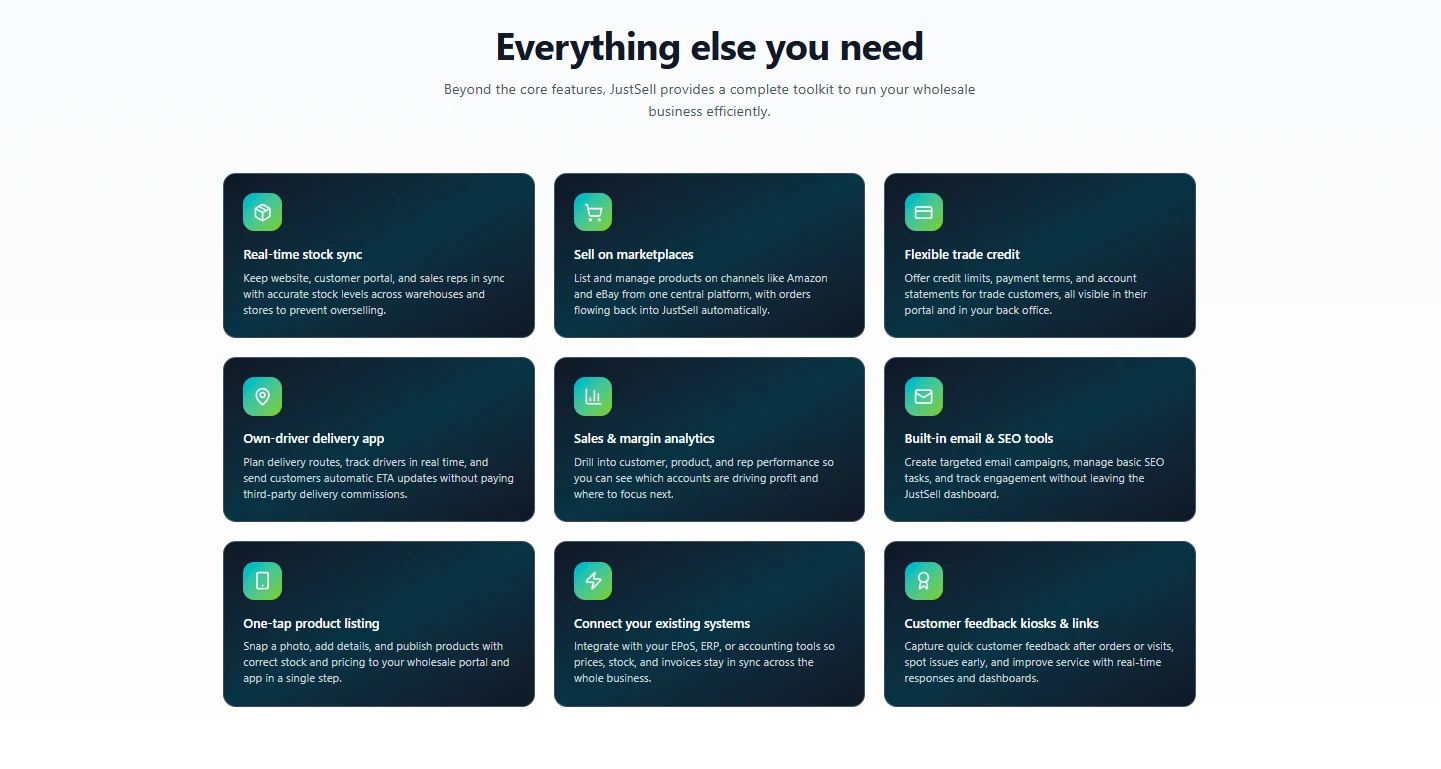
JustSell also supports:
- B2B and B2C ecommerce
- Wholesale ecommerce
- Integrated EPoS
- Inventory management
- Customer ordering apps
- Multi-channel selling
- Ecommerce SEO tools
- CRM functionality
The outcome is often less administration, improved visibility and a smoother buying experience for customers.
Most importantly, businesses can focus more on growth and customer service rather than managing disconnected processes.
Conclusion
Success in ecommerce is rarely about having the most attractive website.
More often, it comes down to avoiding costly operational mistakes.
The businesses that perform best typically:
- Choose scalable ecommerce software
- Maintain accurate inventory management
- Support B2B customer requirements
- Invest in ecommerce SEO and marketing
- Centralise systems and automate processes
As E-commerce B2B continues to grow, businesses that simplify operations and improve customer experiences will be best positioned for long-term success.
If you're looking for a simpler way to manage online sales, stock, customer ordering and business operations from one place, it's worth exploring what JustSell can offer.
Frequently Asked Questions
E-commerce B2B refers to online selling between businesses rather than directly to consumers. It often includes trade pricing, bulk ordering, account management and customer-specific pricing structures.
The best ecommerce platform should match your current requirements while supporting future growth. Consider scalability, inventory management, B2B functionality, integrations, automation and reporting capabilities.
Inventory management software should provide real-time stock visibility, automated updates and centralised control across all sales channels. This helps reduce overselling and stock inaccuracies.
Ecommerce SEO helps online stores appear in search engine results, increasing visibility and attracting potential customers without relying entirely on paid advertising.
Yes. JustSell supports wholesale ecommerce through features such as customer-specific pricing, trade ordering, inventory management and customer ordering capabilities, making it suitable for many B2B and wholesale businesses.
Related Articles

How Manufacturing and Engineering Parts Distributors Can Increase Sales and Improve Customer Ordering with Wholesale Ecommerce
Manufacturing buyers judge a supplier on how easy it is to order, not only on price. This guide covers the cost of manual ordering, how self-service and customer-specific pricing increase sales, and why faster reordering drives repeat business.

How Vape Wholesalers Can Speed Up Retailer Reordering and Increase Repeat Sales
If a retailer has to rebuild the same order every week, some weeks they will not bother. This guide covers how repeat orders are really placed, what slow ordering costs, and how order history and branded ordering apps speed it up.
B2B Wholesale E-Commerce Software: What Trade Suppliers Really Need Before Selling Online
Wholesale ecommerce is not consumer ecommerce with trade prices bolted on. This guide sets out how the two differ, the problems B2B software has to solve, and follows a builders merchant through the move online.