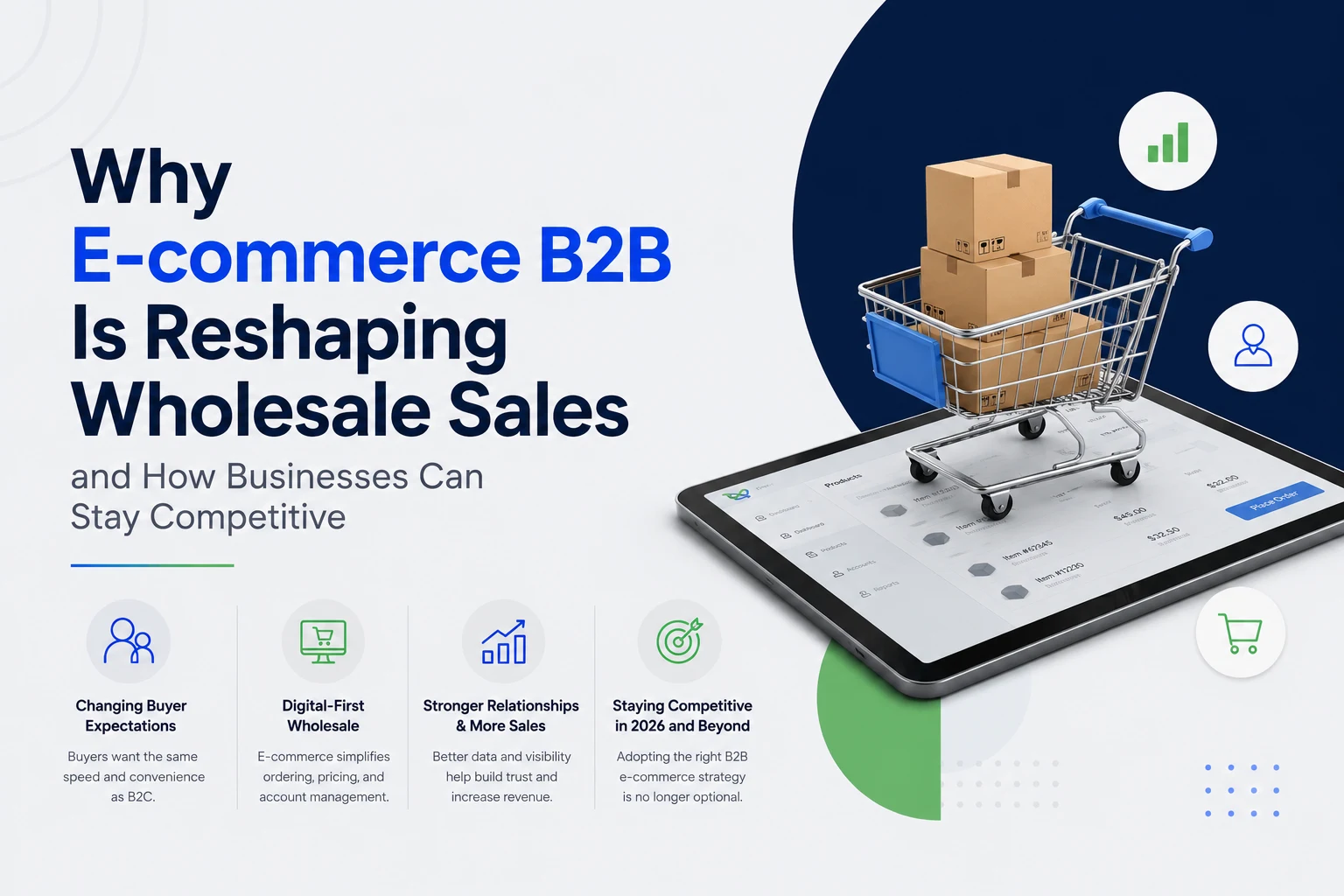
Why E-commerce B2B Is Reshaping Wholesale Sales and How Businesses Can Stay Competitive
Synopsis
What B2B ecommerce is, why it is growing so quickly, and the features a B2B site needs. Covers starting an online store for trade customers, inventory management, multi-channel selling, SEO, and the mistakes made when choosing software.
Table of Contents
- 1.Introduction
- 2.What Is E-commerce B2B?
- 3.Why E-commerce B2B Is Growing So Quickly
- 4.Key Features Every B2B Ecommerce Website Should Have
- 5.How to Start an Online Store for B2B Customers
- 6.The Importance of Ecommerce Inventory Management
- 7.Why Multi-Channel Selling Matters
- 8.Ecommerce SEO: Driving More Qualified Traffic
- 9.Common Mistakes Businesses Make When Choosing Ecommerce Software
- 10.How JustSell Helps
- 11.Frequently Asked Questions
- 12.Conclusion
Introduction
For years, many wholesalers, distributors and manufacturers relied on phone orders, spreadsheets, emailed price lists and manual stock checks to manage customer sales. While those methods may have worked in the past, today's buyers expect something very different.
Business customers increasingly want the same convenience they experience when shopping online as consumers. They expect instant access to products, real-time stock visibility, personalised pricing and the ability to place orders whenever it suits them.
This shift has made E-commerce B2B one of the fastest-growing areas of digital commerce. Businesses that embrace online selling are finding new ways to improve customer service, reduce administration and grow revenue, while those that delay risk losing customers to more digitally capable competitors.
In this guide, we'll explore what E-commerce B2B is, why it matters, the challenges businesses face when implementing it, and what to look for when choosing the best ecommerce platform for your organisation.
What Is E-commerce B2B?
E-commerce B2B (Business-to-Business ecommerce) refers to the online sale of products or services between businesses rather than directly to consumers.
Examples include:
- A wholesaler supplying retailers
- A manufacturer selling directly to distributors
- A food supplier serving restaurants
- An industrial equipment supplier selling to contractors
- A trade merchant supplying building companies
Unlike B2C ecommerce, B2B transactions often involve:
- Customer-specific pricing
- Volume discounts
- Repeat orders
- Credit accounts
- Complex product catalogues
- Multiple users within one customer account
As a result, B2B ecommerce platforms need functionality that goes beyond a standard online shop.
Why E-commerce B2B Is Growing So Quickly
Recent industry research consistently shows that B2B ecommerce sales are growing faster than many traditional sales channels.
Several factors are driving this growth:
Buyers Expect Digital Convenience
Business buyers increasingly prefer self-service purchasing.
Instead of calling sales teams to check stock or request pricing, customers want to:
- Browse products online
- Place orders instantly
- Access account history
- Download invoices
- Track deliveries
The easier you make the buying process, the more likely customers are to place repeat orders.
Businesses Want Greater Efficiency
Manual order processing consumes valuable time.
When staff spend hours:
- Entering orders
- Updating stock records
- Creating invoices
- Managing pricing spreadsheets
productivity suffers.
Ecommerce automation can remove much of this workload, allowing teams to focus on sales growth and customer service.
Customers Buy Outside Office Hours
Many B2B buyers place orders early in the morning, late at night or during weekends.
An online store never closes.
That means businesses can continue generating revenue even when staff aren't available.
Key Features Every B2B Ecommerce Website Should Have
Not all ecommerce software is designed for wholesale and trade sales.
When evaluating solutions, look for features that support the realities of B2B trading.
Customer-Specific Pricing
Different customers often receive different prices.
A good B2B ordering platform should allow:
- Contract pricing
- Trade discounts
- Customer groups
- Tiered pricing structures
This removes the need for manual price lists and reduces errors.
Wholesale Ordering System Functionality
Business customers frequently place large repeat orders.
Features that help include:
- Quick order forms
- Product code ordering
- Saved order templates
- Bulk ordering tools
These can dramatically reduce ordering time for customers.
Inventory Management Software
Stock visibility is critical.
Without accurate inventory data, businesses risk:
- Overselling products
- Delayed deliveries
- Customer dissatisfaction
Integrated inventory management software allows businesses to:
- Monitor stock levels
- Track movements
- Manage multiple locations
- Forecast demand
Customer Ordering Apps
Mobile ordering is becoming increasingly important.
A customer ordering app can allow trade customers to:
- Place orders from site locations
- Check stock availability
- View account information
- Reorder previous purchases
This adds convenience and encourages repeat business.
How to Start an Online Store for B2B Customers
Businesses often assume launching a B2B ecommerce website will be complicated.
In reality, the process can be broken into manageable stages.
Step 1: Define Your Customer Requirements
Start by understanding:
- Who will use the platform?
- What products will be sold?
- How pricing works?
- How orders are currently processed?
The answers will shape platform requirements.
Step 2: Organise Product Data
Before launching, ensure you have:
- Product descriptions
- Product images
- Pricing information
- Stock records
- Product categories
Clean data creates a better customer experience.
Step 3: Choose the Right Ecommerce Software
The best ecommerce platform should fit your business model.
Key considerations include:
- Scalability
- Ease of use
- Integration capabilities
- Inventory management
- Wholesale functionality
- SEO capabilities
Step 4: Test Before Launch
Involve staff and customers during testing.
Check:
- Ordering processes
- Payment workflows
- Stock synchronisation
- Customer account functionality
Identifying issues early can prevent costly mistakes later.
The Importance of Ecommerce Inventory Management
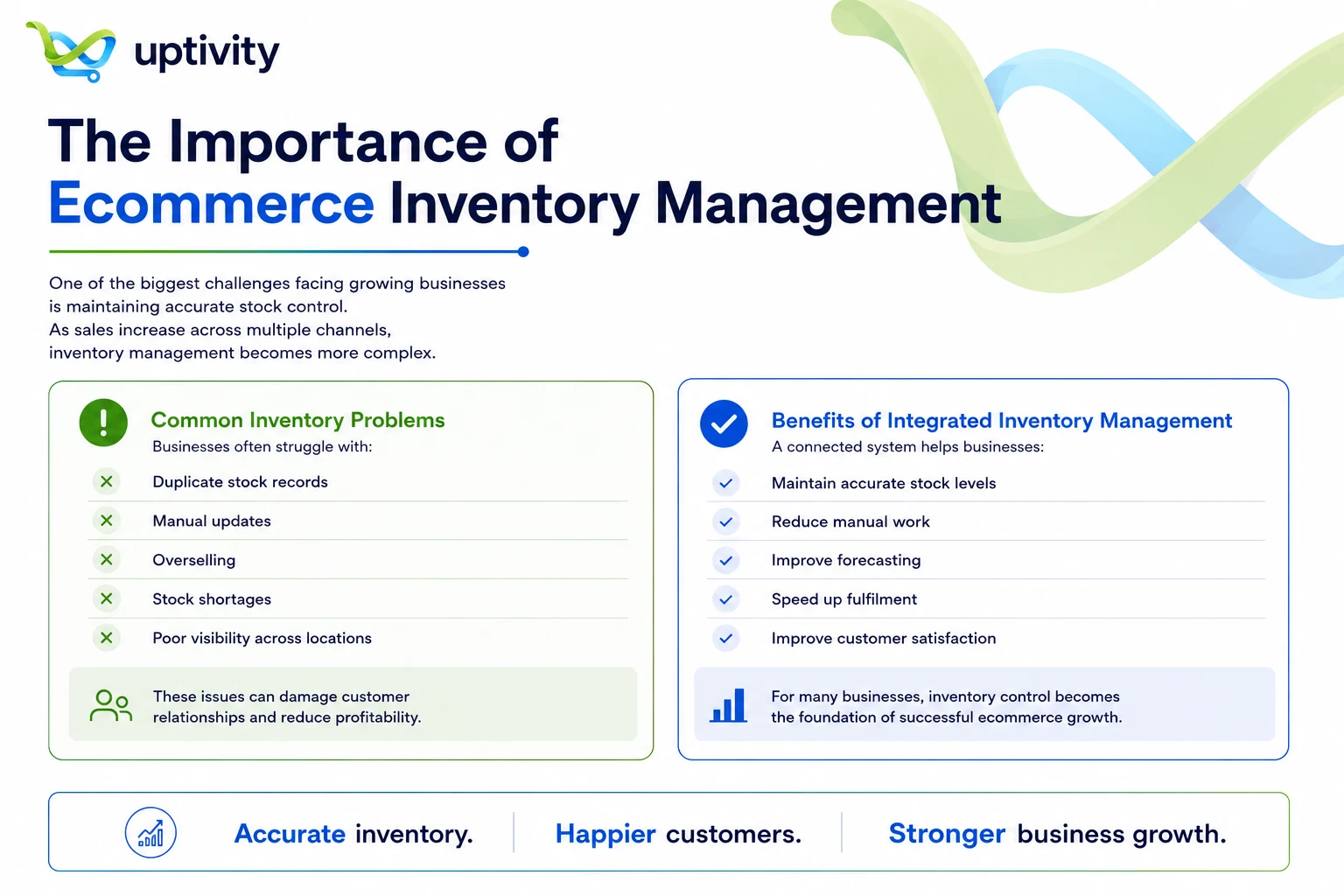
One of the biggest challenges facing growing businesses is maintaining accurate stock control.
As sales increase across multiple channels, inventory management becomes more complex.
Common Inventory Problems
Businesses often struggle with:
- Duplicate stock records
- Manual updates
- Overselling
- Stock shortages
- Poor visibility across locations
These issues can damage customer relationships and reduce profitability.
Benefits of Integrated Inventory Management
A connected system helps businesses:
- Maintain accurate stock levels
- Reduce manual work
- Improve forecasting
- Speed up fulfilment
- Improve customer satisfaction
For many businesses, inventory control becomes the foundation of successful ecommerce growth.
Why Multi-Channel Selling Matters
Today's customers discover products through many different channels.
Relying on a single sales channel can limit growth opportunities.
Popular Sales Channels
Businesses may sell through:
- Their ecommerce website
- Online marketplaces
- Physical stores
- Sales representatives
- Mobile ordering apps
Managing these channels separately often creates operational challenges.
The Advantage of Centralised Management
The most effective ecommerce software centralises:
- Products
- Pricing
- Inventory
- Orders
- Customer information
This reduces duplication and improves visibility across the business.
Ecommerce SEO: Driving More Qualified Traffic
A great online store is only valuable if customers can find it.
That's where ecommerce SEO becomes essential.
Why SEO Matters
Search engines remain one of the most effective sources of long-term website traffic.
Strong SEO can help businesses:
- Increase visibility
- Attract qualified visitors
- Reduce advertising costs
- Generate consistent enquiries
Ecommerce SEO Best Practices
Focus on:
- Product-specific pages
- Clear category structures
- Optimised page titles
- Unique product descriptions
- Fast website performance
- Mobile-friendly design
Businesses that invest in SEO often benefit from a steady stream of potential customers actively searching for their products.
Common Mistakes Businesses Make When Choosing Ecommerce Software
Many businesses focus solely on website design.
However, operational functionality often has a much greater impact on long-term success.
Choosing Based on Price Alone
The cheapest solution may create costly limitations later.
Consider total value rather than monthly subscription costs.
Ignoring Inventory Management
Poor stock control can quickly undermine growth.
Inventory management software should be a core consideration.
Failing to Consider Future Growth
Your requirements today may look very different in three years.
Choose a platform that can scale alongside the business.
Overlooking Customer Experience
Business customers expect simplicity.
Complicated ordering processes often lead to abandoned purchases and frustrated customers.
How JustSell Helps
Businesses moving towards E-commerce B2B often face a common challenge: they need more than a website.
They need a system that brings together sales, stock management, customer ordering and operational processes.
JustSell has been designed to help businesses manage these areas from a single platform.
For wholesalers, distributors, manufacturers and retailers, this can mean reducing the number of separate systems needed to run daily operations.
For example:
- A wholesaler can provide trade customers with online ordering while maintaining customer-specific pricing.
- A retailer can manage online and in-store sales through a connected ecommerce and EPoS environment.
- A growing business can centralise stock, orders and customer information rather than updating multiple systems manually.
- Multi-location businesses can gain better visibility of inventory and sales activity across the organisation.
Because JustSell supports both B2B and B2C ecommerce, businesses can serve trade customers and consumer customers through a single platform where appropriate.
Features such as inventory management, wholesale ordering, customer ordering apps, multi-channel selling and integrated business management tools help reduce administration while giving customers a more convenient purchasing experience.
Most importantly, businesses can focus on improving customer service and growing sales rather than managing disconnected systems.
Frequently Asked Questions
E-commerce B2B refers to online transactions between businesses. Examples include wholesalers selling to retailers, manufacturers supplying distributors and trade suppliers serving commercial customers through digital ordering systems.
The best ecommerce platform depends on your requirements. Businesses should look for customer-specific pricing, inventory management, wholesale ordering tools, scalability and integration capabilities.
Start by organising product data, defining customer requirements, choosing suitable ecommerce software and testing ordering processes before launch. A dedicated B2B ordering platform can significantly simplify the process.
Inventory management software helps maintain accurate stock levels, reduce overselling, improve forecasting and support efficient order fulfilment across multiple sales channels.
Yes. JustSell supports wholesale ecommerce operations with customer-specific pricing, customer ordering capabilities, inventory management, multi-channel selling and tools designed to help businesses manage trade and online sales more efficiently.
Conclusion
The growth of E-commerce B2B is changing how wholesalers, distributors, manufacturers and retailers operate.
Customers increasingly expect fast, convenient and self-service purchasing experiences, while businesses need better visibility, efficiency and scalability.
Success depends on choosing ecommerce software that supports both customer needs and internal operations.
When evaluating solutions, pay particular attention to:
- Inventory management
- Wholesale ordering functionality
- Customer experience
- Ecommerce SEO
- Multi-channel selling
- Future scalability
Businesses that invest in the right foundations today will be better positioned to compete tomorrow.
If you're looking for a simpler way to manage online sales, stock, customer ordering and business operations from one place, it's worth exploring what JustSell can offer.
Related Articles

How Manufacturing and Engineering Parts Distributors Can Increase Sales and Improve Customer Ordering with Wholesale Ecommerce
Manufacturing buyers judge a supplier on how easy it is to order, not only on price. This guide covers the cost of manual ordering, how self-service and customer-specific pricing increase sales, and why faster reordering drives repeat business.

How Vape Wholesalers Can Speed Up Retailer Reordering and Increase Repeat Sales
If a retailer has to rebuild the same order every week, some weeks they will not bother. This guide covers how repeat orders are really placed, what slow ordering costs, and how order history and branded ordering apps speed it up.
B2B Wholesale E-Commerce Software: What Trade Suppliers Really Need Before Selling Online
Wholesale ecommerce is not consumer ecommerce with trade prices bolted on. This guide sets out how the two differ, the problems B2B software has to solve, and follows a builders merchant through the move online.