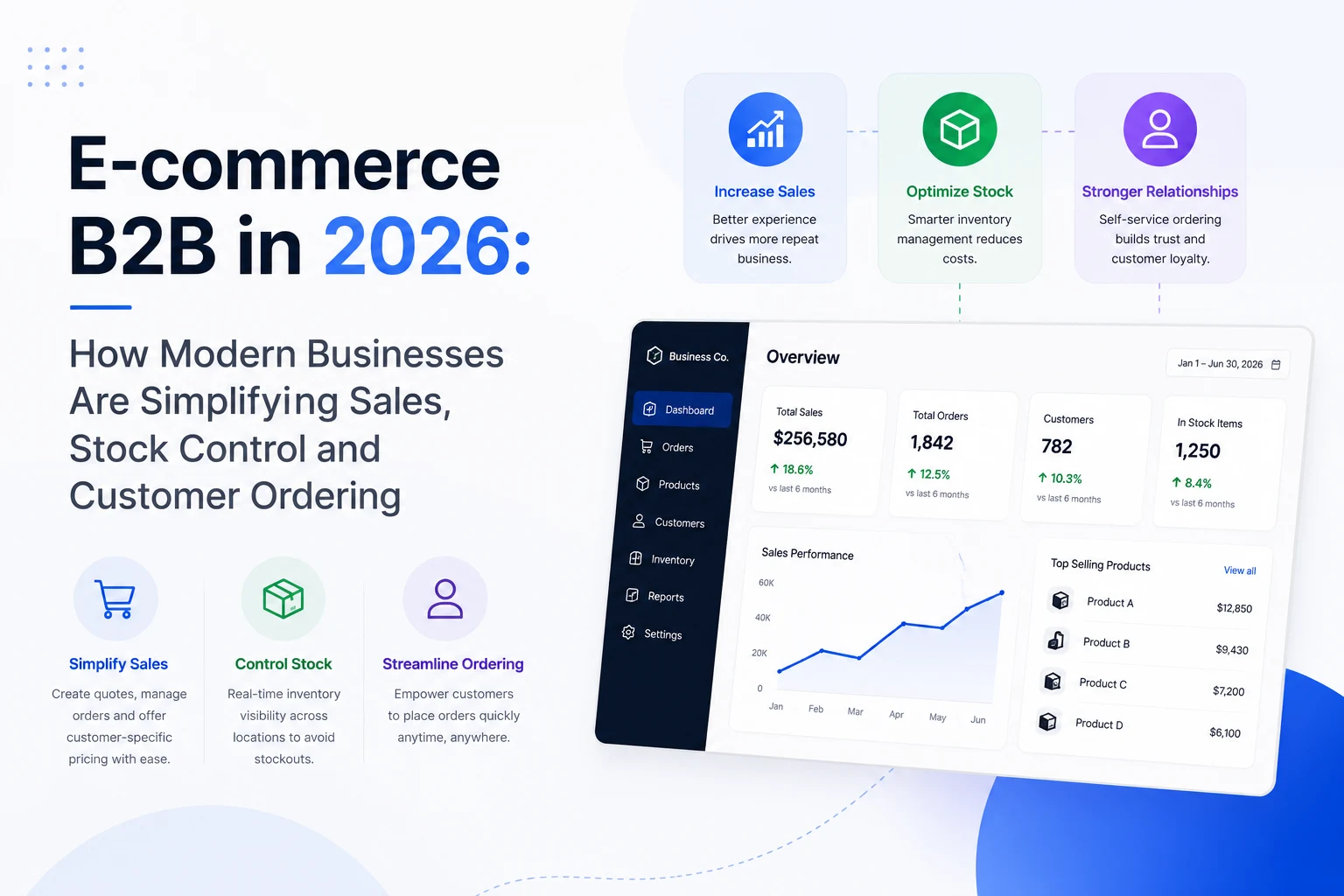
E-commerce B2B in 2026: How Modern Businesses Are Simplifying Sales, Stock Control and Customer Ordering
Synopsis
Why businesses are moving to B2B ecommerce and what the move involves. Covers the features a platform should include, how to start an online store for trade customers, the common challenges, inventory management and marketing.
Table of Contents
- 1.Introduction
- 2.What Is E-commerce B2B?
- 3.Why More Businesses Are Moving to B2B Ecommerce
- 4.Key Features Every B2B Ecommerce Platform Should Include
- 5.How to Start an Online Store for B2B Customers
- 6.Common Challenges in B2B Ecommerce
- 7.Why Ecommerce Inventory Management Matters More Than Ever
- 8.Ecommerce Marketing Strategies That Drive Growth
- 9.How JustSell Helps
- 10.Choosing the Best Ecommerce Platform for Long-Term Growth
- 11.Frequently Asked Questions
- 12.Conclusion
Introduction
Many businesses reach a point where spreadsheets, phone orders and disconnected systems start holding them back.
What worked when you had a handful of customers often becomes difficult to manage as sales grow, product ranges expand and customers expect faster service.
This is particularly true in E-commerce B2B, where businesses need to manage customer-specific pricing, wholesale orders, stock availability, invoicing and multiple sales channels simultaneously.
The challenge isn't simply selling online. It's creating a system that allows customers to order easily while giving your team complete visibility over products, inventory, pricing and orders.
In this guide, you'll learn:
- What E-commerce B2B means today
- How B2B ecommerce differs from traditional online retail
- The key features businesses should look for
- Common mistakes to avoid
- How modern ecommerce software can improve operations
- How platforms such as JustSell help businesses manage growth
Whether you're a wholesaler, manufacturer, distributor or growing retailer, understanding the modern B2B ecommerce landscape can help you make better technology decisions.
What Is E-commerce B2B?
E-commerce B2B (Business-to-Business Ecommerce) refers to businesses selling products or services online to other businesses rather than directly to consumers.
Examples include:
- A food wholesaler supplying restaurants
- A manufacturer selling to distributors
- An industrial supplier selling to contractors
- A retailer ordering stock from a supplier portal
The global B2B ecommerce market continues to grow rapidly. Industry research consistently shows that B2B ecommerce transactions significantly exceed B2C ecommerce sales in value.
Businesses increasingly expect the same convenient online buying experience they receive as consumers.
That means:
- Online ordering
- Real-time stock availability
- Customer-specific pricing
- Mobile access
- Self-service account management
- Fast delivery information
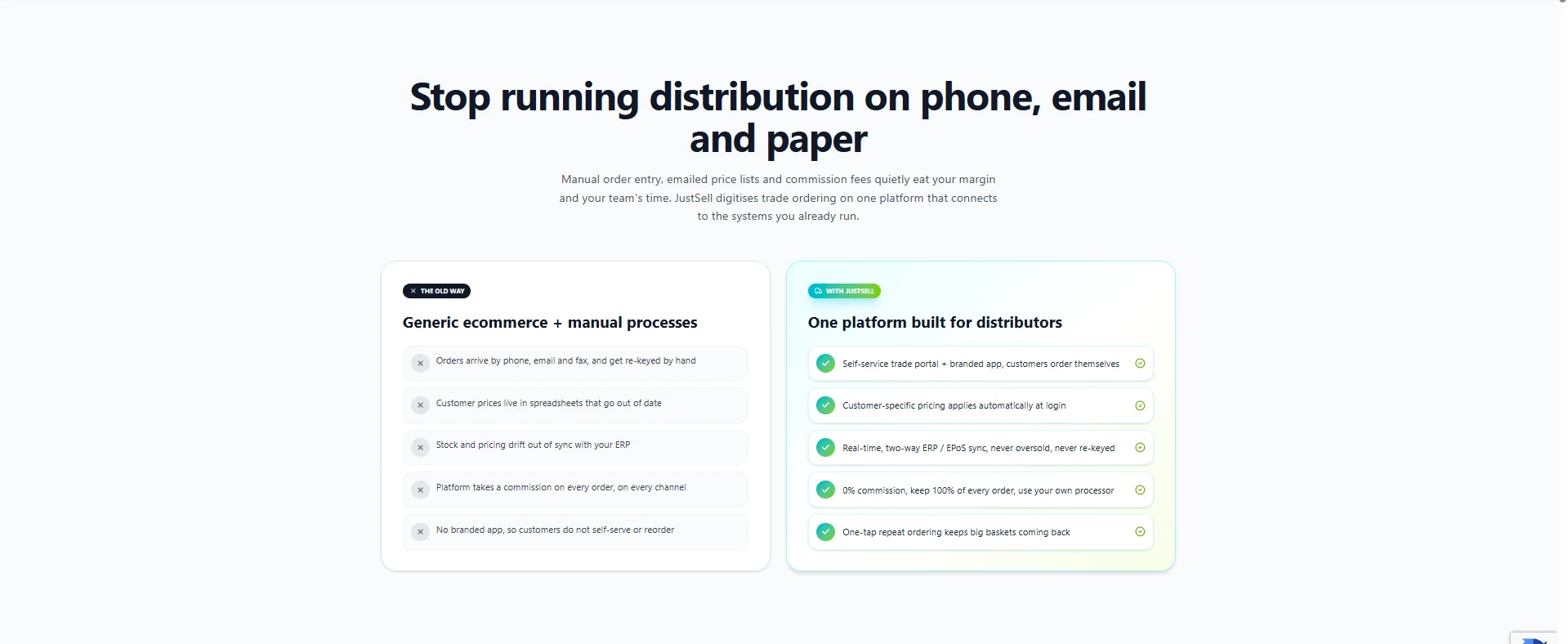
Companies still relying on phone, email or paper-based ordering processes often struggle to keep pace.
Why More Businesses Are Moving to B2B Ecommerce
Customers Expect Self-Service Ordering
Business buyers want convenience.
Rather than calling sales teams to place routine orders, many customers prefer to:
- Browse products online
- Check stock availability
- Reorder previous purchases
- Access invoices
- Track deliveries
A dedicated B2B ordering platform allows customers to manage much of this independently.
Improved Accuracy
Manual order entry creates opportunities for mistakes.
Common issues include:
- Incorrect quantities
- Wrong pricing
- Duplicate orders
- Missed product updates
Online ordering reduces these risks because customers place orders directly into the system.
Better Scalability
As order volumes increase, manual processes become expensive.
Ecommerce automation helps businesses process larger volumes of orders without needing proportional increases in administration staff.
Key Features Every B2B Ecommerce Platform Should Include
Not all ecommerce software is designed for B2B requirements.
Here are some of the most important capabilities to consider.
Customer-Specific Pricing
Many wholesalers and distributors offer different pricing to different customers.
A strong B2B ordering platform should allow:
- Trade pricing
- Tiered pricing
- Volume discounts
- Contract pricing
Without these capabilities, sales teams often end up manually adjusting orders.
Inventory Visibility
Stock control is critical.
Customers need confidence that products are available before ordering.
Effective inventory management software should provide:
- Real-time stock levels
- Low-stock alerts
- Multi-location inventory control
- Automated stock adjustments
Fast Reordering
Many B2B purchases are repeat orders.
Businesses should be able to:
- Reorder from order history
- Save favourites
- Build recurring order lists
This improves customer satisfaction while reducing order friction.
Multi-Channel Selling
Modern businesses rarely sell through a single channel.
Sales may come from:
- Ecommerce websites
- Sales representatives
- Physical stores
- Customer ordering apps
- Online marketplaces
Managing these channels from one system improves consistency and reduces duplication.
How to Start an Online Store for B2B Customers
Many business owners searching for how to start an online store assume the process is mainly about website design.
In reality, operational planning is equally important.
Step 1: Define Your Sales Process
Ask yourself:
- How do customers currently order?
- Do different customers receive different pricing?
- How is stock managed?
- How are deliveries organised?
Understanding these processes helps identify system requirements.
Step 2: Organise Product Data
Before launching an online store:
- Standardise product descriptions
- Add images
- Review pricing structures
- Categorise products
Clean data creates a better customer experience.
Step 3: Choose the Right Ecommerce Software
The best ecommerce platform isn't necessarily the most expensive.
Instead, focus on:
- Scalability
- Ease of use
- Inventory management
- Integration options
- Customer ordering functionality
- Total cost of ownership
Step 4: Optimise for Search Engines
Even B2B businesses benefit from ecommerce SEO.
Search visibility helps attract:
- New trade customers
- Regional buyers
- Industry-specific searches
- Product-based enquiries
A properly optimised ecommerce website can generate leads continuously.
Common Challenges in B2B Ecommerce
Complex Pricing Structures
Many B2B businesses have:
- Negotiated pricing
- Volume discounts
- Regional pricing
- Customer-specific agreements
Managing these manually becomes increasingly difficult as customer numbers grow.
Inventory Management Across Locations
Businesses operating multiple warehouses or branches often struggle with stock visibility.
Without centralised inventory management software, overselling and stock discrepancies can occur.
Managing Multiple Sales Channels
A customer may:
- Visit a branch
- Order through a sales representative
- Place orders online
- Use a mobile ordering app
Without integrated systems, data becomes fragmented.
Customer Experience Expectations
Business buyers increasingly expect:
- Fast websites
- Mobile ordering
- Accurate stock information
- Immediate confirmations
Meeting these expectations requires modern ecommerce infrastructure.
Why Ecommerce Inventory Management Matters More Than Ever
Inventory management is often the hidden factor behind ecommerce success.
Poor stock management leads to:
- Lost sales
- Delayed deliveries
- Frustrated customers
- Excess inventory
Effective inventory management software helps businesses:
- Forecast demand
- Improve stock accuracy
- Reduce stockouts
- Improve cash flow
For growing businesses, inventory visibility is often just as important as generating sales.
Ecommerce Marketing Strategies That Drive Growth
Launching an ecommerce website is only the beginning.
Successful businesses invest in ongoing ecommerce marketing.
Search Engine Optimisation (SEO)
Ecommerce SEO helps products appear in search results when buyers are actively looking for solutions.
Examples include:
- Industry-specific product searches
- Wholesale supply searches
- Local supplier searches
Email Marketing
Existing customers often generate the highest return.
Regular communication can promote:
- New products
- Seasonal offers
- Reorder reminders
- Industry updates
Customer Retention
Acquiring new customers is expensive.
Retention strategies often deliver greater profitability.
Focus on:
- Excellent service
- Easy ordering
- Fast fulfilment
- Consistent communication
Data-Driven Decisions
Modern ecommerce software provides valuable insights into:
- Customer behaviour
- Product performance
- Sales trends
- Marketing effectiveness
These insights support better decision-making.
How JustSell Helps
Many businesses reach a stage where separate systems for ecommerce, stock control, customer management and sales channels create unnecessary complexity.
JustSell was designed to address these challenges by bringing key business operations together in one platform.
For businesses operating in E-commerce B2B, this can mean:
- Giving customers a professional online ordering experience
- Managing wholesale pricing structures more effectively
- Maintaining accurate stock visibility across products and locations
- Centralising product, order and customer information
- Supporting both B2B and B2C sales from the same system
For example, a wholesaler could allow trade customers to place orders online while simultaneously managing inventory, pricing and fulfilment from a single platform.
A retailer operating multiple locations could combine ecommerce, inventory management and integrated EPoS functionality to improve visibility across the business.
Businesses using customer ordering apps can also provide a more convenient buying experience while reducing manual order processing.
Importantly, JustSell uses fixed monthly pricing with 0% commission on sales, helping businesses retain more of their revenue as they grow.
Rather than replacing processes with multiple disconnected tools, the goal is to simplify online sales management and improve operational efficiency.
Choosing the Best Ecommerce Platform for Long-Term Growth
When evaluating the best ecommerce platform, focus on future requirements rather than current limitations.
Consider questions such as:
- Will the platform support wholesale ecommerce?
- Can it manage customer-specific pricing?
- Does it include inventory management?
- Can it support multiple sales channels?
- Will it scale with growth?
- Are integrations available when needed?
The right platform should support your business today while remaining capable of supporting tomorrow's growth.
Frequently Asked Questions
E-commerce B2B refers to businesses selling products or services online to other businesses. Examples include wholesalers, manufacturers, distributors and trade suppliers using online ordering systems.
Look for inventory management, customer-specific pricing, scalability, integration options, ecommerce SEO tools and support for multiple sales channels.
The best ecommerce platform depends on your requirements. Wholesale businesses typically benefit from features such as trade pricing, customer ordering portals, inventory control and online sales management tools.
Inventory management software helps maintain accurate stock levels, reduce stockouts, improve forecasting and provide customers with reliable availability information.
Yes. JustSell supports B2B ecommerce requirements including wholesale ordering, customer-specific pricing, inventory management, customer ordering apps and centralised sales management, making it suitable for wholesalers,
Conclusion
The world of E-commerce B2B continues to evolve rapidly.
Business buyers expect online ordering, real-time stock visibility, personalised pricing and a seamless purchasing experience.
Companies that continue relying on manual processes often find growth increasingly difficult to manage.
By investing in the right ecommerce software, businesses can improve customer experience, strengthen inventory control, automate routine processes and create a stronger foundation for long-term growth.
Whether you're exploring how to start an online store, evaluating inventory management software or searching for the best ecommerce platform, the key is choosing technology that simplifies operations rather than adding complexity.
If you're looking for a simpler way to manage online sales, stock, customer ordering and business operations from one place, it's worth exploring what JustSell can offer.
distributors and manufacturers.
Related Articles

How Manufacturing and Engineering Parts Distributors Can Increase Sales and Improve Customer Ordering with Wholesale Ecommerce
Manufacturing buyers judge a supplier on how easy it is to order, not only on price. This guide covers the cost of manual ordering, how self-service and customer-specific pricing increase sales, and why faster reordering drives repeat business.

How Vape Wholesalers Can Speed Up Retailer Reordering and Increase Repeat Sales
If a retailer has to rebuild the same order every week, some weeks they will not bother. This guide covers how repeat orders are really placed, what slow ordering costs, and how order history and branded ordering apps speed it up.
B2B Wholesale E-Commerce Software: What Trade Suppliers Really Need Before Selling Online
Wholesale ecommerce is not consumer ecommerce with trade prices bolted on. This guide sets out how the two differ, the problems B2B software has to solve, and follows a builders merchant through the move online.