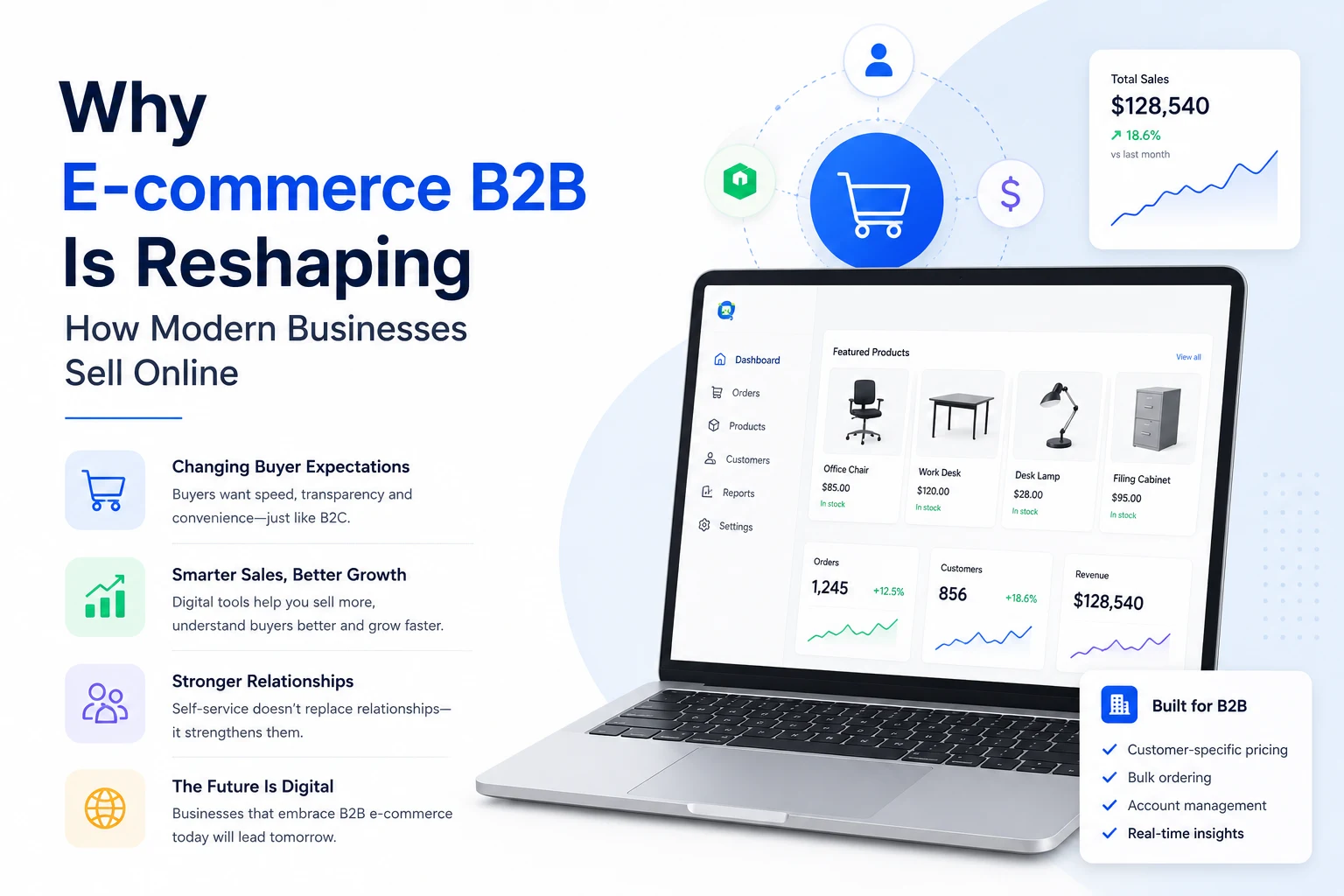
Why E-commerce B2B Is Reshaping How Modern Businesses Sell Online
Synopsis
The growth of B2B ecommerce and what holds businesses back. Covers what makes a platform successful, why inventory management is critical, multi-channel selling, marketing, and the signs a business has outgrown its current setup.
Table of Contents
- 1.Introduction
- 2.The Growth of E-commerce B2B
- 3.Why Traditional Ordering Methods Are Holding Businesses Back
- 4.What Makes a Successful E-commerce B2B Platform?
- 5.Why Ecommerce Inventory Management Is Critical
- 6.Multi-Channel Selling Creates New Opportunities
- 7.How Ecommerce Marketing Supports Long-Term Growth
- 8.What Businesses Should Consider When Choosing Ecommerce Software
- 9.How JustSell Helps
- 10.Signs Your Business Has Outgrown Its Current Ecommerce Setup
- 11.The Future of E-commerce B2B
- 12.Frequently Asked Questions
Introduction
The way businesses buy and sell products has changed dramatically over the past decade. Buyers now expect the same convenience, speed and transparency from business suppliers that they experience when shopping as consumers online.
For wholesalers, manufacturers, distributors and trade suppliers, this shift has made E-commerce B2B more important than ever. Customers want to browse products, check pricing, place orders, view account information and track deliveries without relying on phone calls, spreadsheets or lengthy email chains.
At the same time, businesses face growing pressure to manage stock accurately, sell across multiple channels and provide a better customer experience while keeping costs under control.
In this article, we'll explore why E-commerce B2B continues to grow, the challenges businesses face when moving online, what to look for in ecommerce software, and how the right platform can help simplify operations while increasing sales.
The Growth of E-commerce B2B
B2B ecommerce is no longer a future trend. It has become a core sales channel for businesses of all sizes.
Research consistently shows that business buyers increasingly prefer digital purchasing experiences. Decision-makers want quick access to product information, personalised pricing, stock availability and order history without waiting for a sales representative.
Several factors are driving this growth:
- Increased buyer expectations
- Remote and hybrid working
- Rising operational costs
- Demand for faster ordering processes
- Expansion into new markets
- Growth of mobile commerce
Businesses that continue to rely heavily on manual ordering processes often struggle to compete against suppliers offering a modern online experience.
Why Traditional Ordering Methods Are Holding Businesses Back
Many wholesalers and distributors still process orders through:
- Telephone
- Paper forms
- Spreadsheets
- Manual stock systems
While these methods may have worked in the past, they often create challenges as a business grows.
Common Problems
Order Errors
Manual data entry increases the risk of mistakes.
Incorrect quantities, pricing errors and missed orders can quickly damage customer relationships.
Poor Stock Visibility
Without proper ecommerce inventory management, businesses often sell products they no longer have available.
This creates frustration for both customers and staff.
Slow Order Processing
Customers increasingly expect immediate confirmation and fast fulfilment.
Manual workflows can create delays at every stage.
Limited Growth Potential
Managing hundreds or thousands of orders manually becomes increasingly difficult as sales increase.
Eventually, operational inefficiencies begin limiting growth.
What Makes a Successful E-commerce B2B Platform?
Not all ecommerce software is designed for B2B selling.
Business buyers often have very different requirements from retail consumers.
A strong B2B ordering platform should support:
Customer-Specific Pricing
Different customers may have negotiated pricing agreements.
The platform should automatically display the correct pricing for each account.
Account-Based Ordering
Business customers often require:
- Multiple users per account
- Purchase order references
- Order approval processes
- Credit account facilities
Bulk Ordering
Many trade buyers purchase large quantities regularly.
Ordering should be fast, simple and efficient.
Self-Service Account Management
Customers should be able to:
- View previous orders
- Reorder products
- Download invoices
- Track deliveries
- Manage account information
This reduces administration while improving customer satisfaction.
Why Ecommerce Inventory Management Is Critical
One of the biggest challenges facing growing ecommerce businesses is inventory control.
Poor stock management can result in:
- Overselling
- Stock shortages
- Excess inventory
- Lost revenue
- Poor customer experiences
Effective ecommerce inventory management provides real-time visibility across the business.
Key Benefits
Improved Stock Accuracy
Staff can instantly see available inventory levels.
Better Purchasing Decisions
Accurate reporting helps businesses forecast demand more effectively.
Reduced Waste
Businesses avoid over-ordering products that may sit unsold.
Faster Fulfilment
Orders can be processed more quickly when inventory data is accurate and accessible.
As online sales channels grow, inventory management software becomes increasingly important for maintaining efficiency.
Multi-Channel Selling Creates New Opportunities
Today's customers discover products through multiple channels.
A business may sell through:
- Its own ecommerce website
- Online marketplaces
- Physical retail locations
- Sales representatives
- Mobile ordering apps
Managing these channels separately can quickly become complicated.
The Benefits of Multi-Channel Selling
Increased Reach
Businesses can access more customers through additional sales channels.
Greater Revenue Opportunities
Customers can purchase through their preferred method.
Reduced Dependence on One Platform
Diversifying sales channels helps reduce risk.
However, success depends on having centralised management of products, stock and orders.
Without this, businesses often face inventory conflicts and operational inefficiencies.
How Ecommerce Marketing Supports Long-Term Growth
Building an online store is only the first step.
Businesses must also attract the right customers.
Effective ecommerce marketing combines several approaches.
Search Engine Optimisation (SEO)
Strong ecommerce SEO helps potential customers find products through search engines.
Important factors include:
- Product page optimisation
- Technical website performance
- Keyword targeting
- Internal linking
- Structured data
Businesses that invest in SEO often benefit from long-term organic traffic growth.
Email Marketing
Email remains one of the highest-performing marketing channels for both B2B and B2C businesses.
It can be used for:
- Promotions
- Customer retention
- Reorders
- Product launches
- Account management
Customer Data and CRM
Understanding customer behaviour allows businesses to deliver more relevant communications and improve sales performance.
What Businesses Should Consider When Choosing Ecommerce Software
The best ecommerce platform is rarely the one with the longest feature list.
Instead, businesses should focus on solving operational challenges.
When evaluating ecommerce software, consider:
Scalability
Will the platform support future growth?
Ease of Use
Can staff learn and use the system efficiently?
Integration Capabilities
Can it connect with existing systems and processes?
Mobile Accessibility
Can customers and staff access key functions on mobile devices?
Total Cost of Ownership
Look beyond the initial subscription cost.
Consider:
- Transaction fees
- Development costs
- Additional software requirements
- Ongoing maintenance
Many businesses discover that low-cost platforms become expensive as complexity increases.
How JustSell Helps
Businesses moving towards E-commerce B2B often face a common challenge.
They end up using multiple disconnected systems for:
- Online sales
- Stock management
- Customer records
- Point of sale
- Wholesale ordering
- Delivery management
This can create duplicate work, inconsistent data and operational inefficiencies.
JustSell approaches the problem differently by bringing these processes together into a single platform.
For wholesalers, distributors and manufacturers, this means customers can place orders online through a dedicated ecommerce website while staff manage products, pricing, stock and customer information from one central system.
For businesses operating both B2B and B2C sales channels, JustSell supports both models within the same environment, reducing the need for separate systems.
Businesses with field sales teams or repeat-order customers can also provide a customer ordering app, making it easier for customers to place orders at any time without relying on manual processes.
Because inventory, orders and customer information are managed centrally, businesses gain better visibility across operations while reducing administrative workload.
Rather than focusing solely on online selling, the platform helps businesses create a connected sales and operational process that can scale as demand grows.
Signs Your Business Has Outgrown Its Current Ecommerce Setup
Many growing businesses don't realise they've outgrown their systems until problems become frequent.
Common warning signs include:
- Staff spending hours entering orders manually
- Stock discrepancies becoming more common
- Customers requesting self-service ordering
- Multiple systems holding different data
- Difficulty managing wholesale customers
- Reporting taking too long
- Increasing operational costs
When these issues appear regularly, it may be time to reassess whether your current platform still supports your business goals.
The Future of E-commerce B2B
The future of B2B selling is becoming increasingly digital.
Buyers expect:
- Faster ordering
- Personalised experiences
- Mobile access
- Accurate stock information
- Self-service account management
Businesses that invest in modern ecommerce systems today are often better positioned to compete tomorrow.
The goal is not simply to sell online.
It's to create a more efficient operation that supports growth while improving the customer experience.
Frequently Asked Questions
E-commerce B2B refers to online transactions between businesses rather than between businesses and consumers. Examples include wholesalers selling to retailers, manufacturers supplying distributors and trade suppliers accepting online orders from business customers.
The best ecommerce platform depends on your business requirements. Important considerations include inventory management, customer-specific pricing, wholesale ordering capabilities, integrations and scalability.
To start an online store for wholesale customers, you'll need ecommerce software that supports trade pricing, account-based purchasing, bulk ordering and customer management. A dedicated B2B ordering platform can help automate many of these processes.
Inventory management software helps businesses maintain accurate stock levels, prevent overselling, improve purchasing decisions and fulfil orders more efficiently across multiple sales channels.
Yes. JustSell supports both B2B and B2C ecommerce operations, allowing businesses to manage online sales, inventory, customer accounts and ordering processes from a central platform while supporting wholesale and retail customers.
The growth of Customers increasingly expect the convenience of online ordering, real-time stock visibility and self-service account management. At the same time, businesses need better ways to manage inventory, streamline operations and support multi-channel selling.
E-commerce B2B is changing how wholesalers, manufacturers, distributors and retailers operate.
Choosing the right ecommerce platform involves more than building an online store. It requires a solution that supports inventory control, customer management, marketing and long-term scalability.
Businesses that invest in the right systems can improve efficiency, reduce manual processes and create better buying experiences for customers.
If you're looking for a simpler way to manage online sales, stock, customer ordering and business operations from one place, it's worth exploring what JustSell can offer.
Related Articles

How Manufacturing and Engineering Parts Distributors Can Increase Sales and Improve Customer Ordering with Wholesale Ecommerce
Manufacturing buyers judge a supplier on how easy it is to order, not only on price. This guide covers the cost of manual ordering, how self-service and customer-specific pricing increase sales, and why faster reordering drives repeat business.

How Vape Wholesalers Can Speed Up Retailer Reordering and Increase Repeat Sales
If a retailer has to rebuild the same order every week, some weeks they will not bother. This guide covers how repeat orders are really placed, what slow ordering costs, and how order history and branded ordering apps speed it up.
B2B Wholesale E-Commerce Software: What Trade Suppliers Really Need Before Selling Online
Wholesale ecommerce is not consumer ecommerce with trade prices bolted on. This guide sets out how the two differ, the problems B2B software has to solve, and follows a builders merchant through the move online.