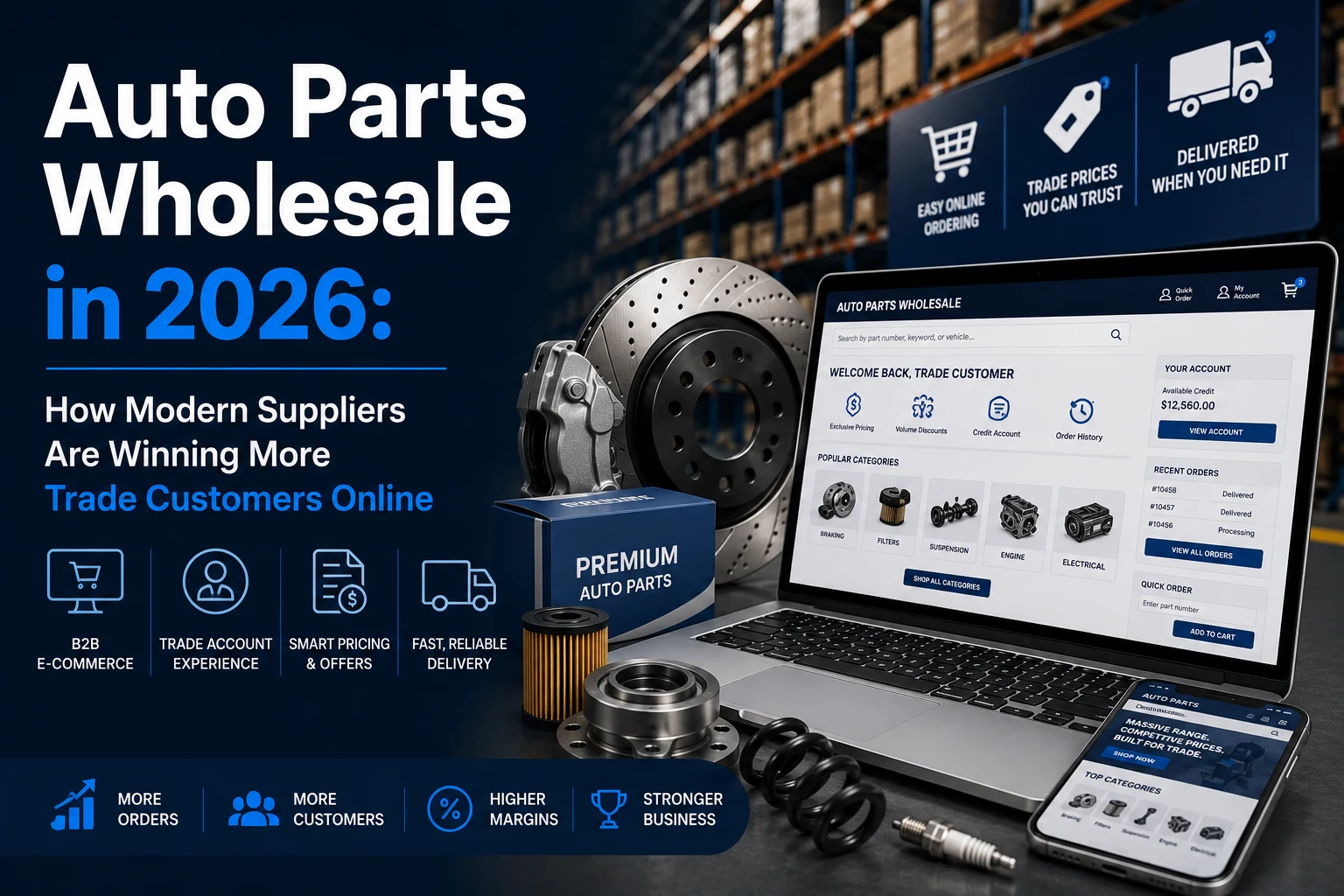
Auto Parts Wholesale in 2026: How Modern Suppliers Are Winning More Trade Customers Online
Synopsis
Why the auto parts market keeps growing and how buyer behaviour is shifting online. Covers OEM versus aftermarket, the challenges facing distributors, finding a supplier, dropshipping, and what to look for in an ecommerce platform.
Table of Contents
- 1.Introduction
- 2.Why the Auto Parts Wholesale Market Continues to Grow
- 3.Choosing Between OEM and Aftermarket Parts
- 4.The Challenges Facing Modern Auto Parts Distributors
- 5.How Online Auto Parts Wholesale Is Changing Buyer Behaviour
- 6.Finding the Right Automotive Wholesale Supplier
- 7.The Rise of E-commerce Auto Parts Businesses
- 8.Should You Consider Dropshipping Auto Parts?
- 9.Building a More Efficient Automotive Distribution Network
- 10.How JustSell Helps
- 11.What to Look for in an Auto Parts Ecommerce Platform
- 12.The Future of Wholesale Auto Parts
- 13.Frequently Asked Questions
- 14.Conclusion
Introduction
The automotive aftermarket has changed dramatically over the past decade. Customers now expect the same convenience when ordering vehicle components as they do when buying consumer products online. At the same time, competition is increasing, margins are under pressure, and supply chain disruptions continue to challenge businesses across the sector.
For companies involved in auto parts wholesale, this creates both opportunities and risks. Businesses that modernise their sales processes, inventory control and customer experience are often gaining market share, while those relying on outdated systems can struggle to keep up.
Whether you're an independent motor factor, a garage owner, an automotive parts reseller or an established automotive wholesale supplier, understanding how the market is evolving can help you make better decisions.
In this article, we'll explore the current state of wholesale auto parts, common challenges facing the industry, and practical ways businesses can improve efficiency, increase sales and strengthen customer relationships.
Why the Auto Parts Wholesale Market Continues to Grow
The global automotive aftermarket industry remains resilient despite economic uncertainty. Vehicles are staying on the road longer, increasing demand for replacement parts, maintenance products and repair components.
Several trends are driving growth:
- Increasing vehicle age across many markets
- Rising repair costs encouraging maintenance over replacement
- Growth in independent repair workshops
- Expansion of online purchasing channels
- Greater availability of aftermarket components
For many businesses, this means there are more opportunities than ever to become a trusted automotive parts supplier serving garages, fleets, retailers and consumers.
However, growth also brings complexity.
Managing thousands of SKUs, multiple suppliers, changing pricing structures and customer expectations requires far more than a basic catalogue and phone ordering system.
Choosing Between OEM and Aftermarket Parts
One of the most important considerations in the automotive sector is understanding the difference between OEM and aftermarket products.
OEM Parts
OEM (Original Equipment Manufacturer) parts are produced by the vehicle manufacturer's approved suppliers.
Benefits include:
- Guaranteed compatibility
- Manufacturer specifications
- Strong customer confidence
Potential drawbacks:
- Higher cost
- Limited supplier options
- Reduced profit margins
Aftermarket Parts
Aftermarket auto parts are manufactured by third-party companies.
Benefits include:
- Competitive pricing
- Wider product selection
- Better margin opportunities
- Availability for older vehicles
Potential drawbacks:
- Quality can vary between manufacturers
- Additional supplier vetting may be required
For many businesses involved in aftermarket auto parts wholesale, success depends on balancing quality, availability and profitability.
The Challenges Facing Modern Auto Parts Distributors
The traditional automotive distribution model has become increasingly difficult to manage.
Inventory Complexity
A typical auto parts distributor may stock tens of thousands of products covering multiple vehicle manufacturers and models.
Common inventory issues include:
- Overstocking slow-moving products
- Running out of high-demand items
- Duplicate stock records
- Inaccurate availability information
Poor automotive inventory management can quickly affect customer service and profitability.
Pricing Pressure
Customers can compare prices across multiple suppliers within minutes.
This creates pressure on:
- Gross margins
- Customer retention
- Supplier negotiations
Businesses must balance competitive pricing with sustainable profitability.
Supply Chain Disruption
Recent years have highlighted vulnerabilities in the global car parts supply chain.
Common challenges include:
- Manufacturer delays
- International shipping issues
- Component shortages
- Rising transport costs
Successful wholesalers increasingly rely on real-time stock visibility and supplier diversification.
How Online Auto Parts Wholesale Is Changing Buyer Behaviour
Trade buyers are increasingly expecting self-service ordering options.
Instead of calling suppliers during office hours, garages and workshops want access to:
- Live stock levels
- Trade pricing
- Order history
- Technical information
- Fast reordering tools
As a result, online auto parts wholesale platforms are becoming a critical sales channel.
Businesses that fail to provide convenient digital ordering often lose customers to competitors that do.
What Trade Customers Expect Today
Modern B2B buyers typically want:
- 24/7 ordering
- Account-specific pricing
- Vehicle-specific search functionality
- Fast delivery options
- Accurate product information
These expectations are reshaping B2B auto parts sales across the industry.
Finding the Right Automotive Wholesale Supplier
Choosing a reliable automotive wholesale supplier can significantly affect customer satisfaction and profitability.
When evaluating suppliers, consider:
Product Availability
Consistent stock availability reduces delays and improves customer retention.
Data Quality
A comprehensive automotive parts catalogue helps customers identify the correct components quickly.
Look for suppliers providing:
- Detailed descriptions
- Technical specifications
- Images
- Vehicle compatibility information
Delivery Performance
Fast, reliable fulfilment often becomes a key competitive advantage.
Evaluate:
- Delivery times
- Carrier options
- Tracking capabilities
- Returns processes
Pricing Stability
Frequent pricing changes can make inventory planning difficult.
Look for suppliers with transparent pricing structures and predictable terms.
The Rise of E-commerce Auto Parts Businesses
Many automotive businesses now generate significant revenue online.
The growth of e-commerce auto parts sales has created opportunities for both established distributors and new entrants.
Popular online sales channels include:
- Dedicated ecommerce websites
- Trade portals
- Marketplaces
- Mobile ordering apps
However, success requires more than simply listing products online.
Businesses must manage:
- Product data
- Stock control
- Customer accounts
- Pricing rules
- Order processing
- Delivery management
Without integrated systems, operational complexity can quickly become overwhelming.
Should You Consider Dropshipping Auto Parts?
For entrepreneurs entering the market, dropshipping auto parts can appear attractive because it reduces the need for upfront inventory investment.
Advantages include:
- Lower startup costs
- Reduced storage requirements
- Wider product range
Disadvantages include:
- Lower margins
- Less control over fulfilment
- Supplier dependency
- Increased customer service challenges
While dropshipping may suit some businesses, many successful automotive resellers eventually move towards holding stock for key product lines.
Building a More Efficient Automotive Distribution Network
Efficiency is becoming one of the biggest competitive advantages in the automotive aftermarket.
Businesses can improve performance by focusing on:
Better Inventory Visibility
Real-time stock tracking reduces errors and improves purchasing decisions.
Centralised Product Management
Managing products from one system helps eliminate duplicate work.
Automated Ordering
Automated purchasing workflows reduce manual administration.
Customer Self-Service
Providing online ordering capabilities often improves customer satisfaction while reducing internal workload.
These improvements can strengthen an entire automotive distribution network.
How JustSell Helps
Managing an automotive parts business often involves balancing inventory, customer service, purchasing, sales and fulfilment across multiple channels.
As businesses grow, disconnected systems can create unnecessary complexity.
JustSell helps automotive wholesalers, distributors and retailers bring these processes together into a single platform.
For example, a business selling wholesale car parts may be managing:
- Trade customer accounts
- Retail ecommerce sales
- Inventory across multiple locations
- Marketplace orders
- Delivery scheduling
Instead of switching between separate systems, these activities can be managed centrally.
For businesses focused on B2B auto parts sales, JustSell supports trade customer ordering, customer-specific pricing and wholesale sales workflows.
Companies selling through multiple channels can manage products, stock and orders from one place, helping reduce manual work and improve stock accuracy.
For automotive businesses with physical locations, integrated EPoS functionality can help connect in-store and online operations.
Businesses looking to grow online can also benefit from ecommerce tools designed to support product visibility, customer ordering and search engine optimisation.
The result is often a more organised operation with greater visibility across sales, inventory and customer activity.
What to Look for in an Auto Parts Ecommerce Platform
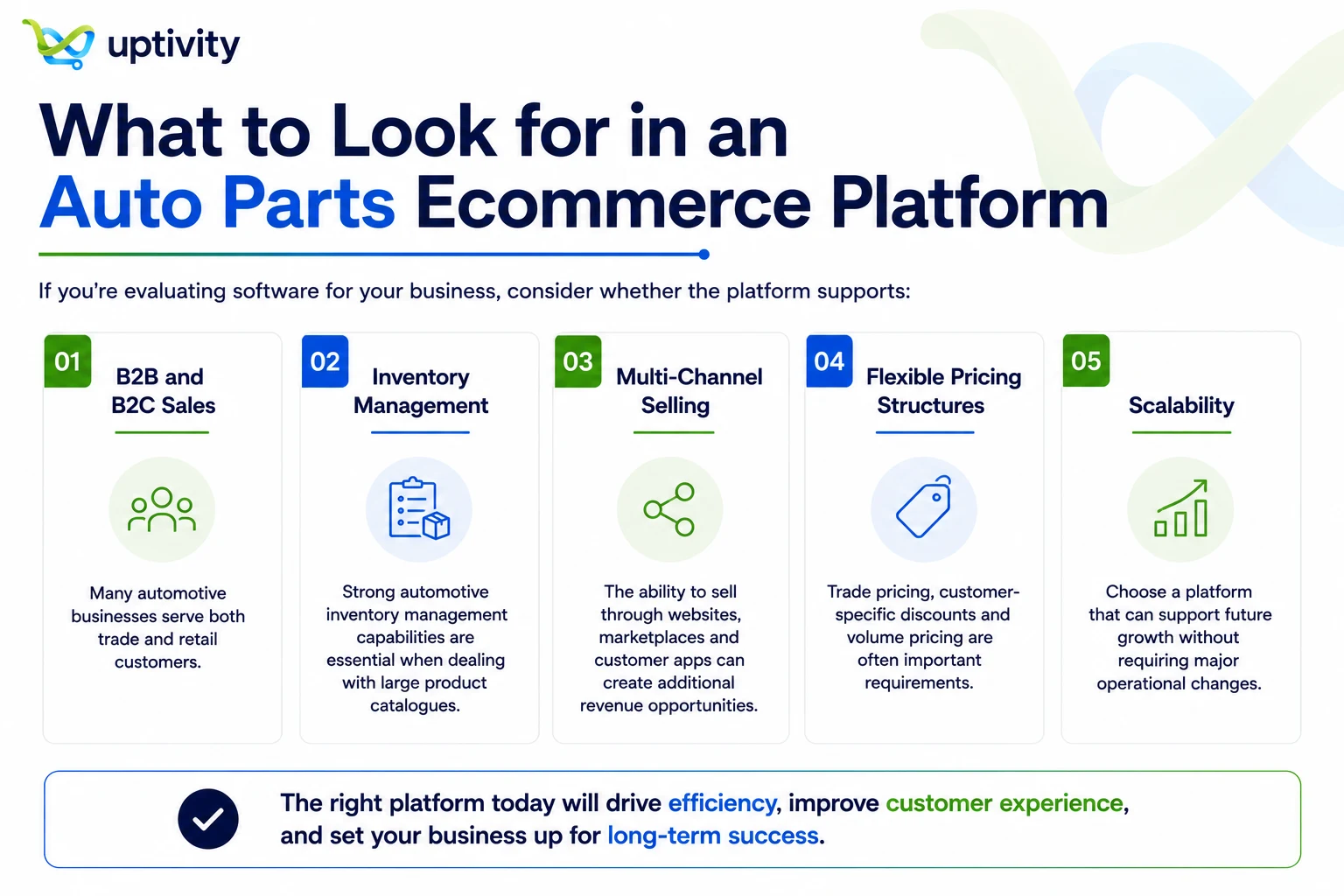
If you're evaluating software for your business, consider whether the platform supports:
B2B and B2C Sales
Many automotive businesses serve both trade and retail customers.
Inventory Management
Strong automotive inventory management capabilities are essential when dealing with large product catalogues.
Multi-Channel Selling
The ability to sell through websites, marketplaces and customer apps can create additional revenue opportunities.
Flexible Pricing Structures
Trade pricing, customer-specific discounts and volume pricing are often important requirements.
Scalability
Choose a platform that can support future growth without requiring major operational changes.
The Future of Wholesale Auto Parts
The automotive sector continues to evolve.
Electric vehicles, connected vehicles and changing consumer expectations will create new opportunities and challenges.
Businesses that invest in digital infrastructure today are often better positioned to adapt to future market changes.
The most successful wholesalers are increasingly focusing on:
- Better customer experiences
- Faster ordering processes
- Accurate inventory control
- Integrated business systems
- Data-driven decision making
Technology alone is not the solution, but it can provide the foundation needed to compete effectively in a rapidly changing market.
Frequently Asked Questions
OEM parts are produced to the vehicle manufacturer's specifications, while aftermarket parts are made by third-party manufacturers. Aftermarket options often offer lower costs and wider availability, although quality can vary between suppliers.
Look for suppliers with strong stock availability, accurate product data, competitive pricing, reliable delivery performance and a proven track record within the automotive aftermarket industry.
A good auto parts ecommerce platform should provide inventory management, customer-specific pricing, multi-channel selling, product catalogue management, order processing and reporting capabilities.
Yes. More garages, workshops and retailers now prefer online ordering because it provides quicker access to stock information, pricing and order history, making procurement more efficient.
Yes. JustSell is designed to support both B2B and B2C sales, making it suitable for automotive businesses that need to manage inventory, trade customer accounts, online ordering and multi-channel sales from a central system.
Conclusion
Success in auto parts wholesale is no longer determined solely by product availability and pricing.
Modern businesses must also deliver accurate inventory information, convenient ordering experiences and efficient operational processes.
Whether you're an established automotive parts supplier, a growing auto parts reseller, or a company looking to expand its online presence, investing in the right systems can improve both customer satisfaction and profitability.
As the automotive aftermarket industry continues to evolve, businesses that embrace digital sales channels, stronger inventory management and streamlined operations will be best placed for long-term success.
If you're looking for a simpler way to manage online sales, stock, customer ordering and business operations from one place, it's worth exploring what JustSell can offer.
Related Articles
How Manufacturing and Engineering Distributors Can Manage Complex Product Catalogues More Effectively
Engineering catalogues run to tens of thousands of SKUs, each with sizes, materials, ratings and certifications. This guide covers why basic ecommerce falls short, how technical product structures and filtering improve discovery, and where customer-specific catalogues help.

How Manufacturing and Engineering Distributors Can Reduce Delays Caused by Quotes and Negotiated Pricing
Manufacturing procurement runs on quotes and negotiated pricing, and every approval adds delay. This guide covers what slow quoting costs, how customer-specific pricing cuts manual enquiries, and how quote-to-order workflows let buyers purchase faster.

Managing Customer-Specific Pricing in Vape Wholesale: How to Reduce Admin and Increase Sales
When every customer has a different price list, pricing turns into admin. This guide covers the types of wholesale pricing, what manual processes cost, and how customer groups, tiers and promotions increase order values.