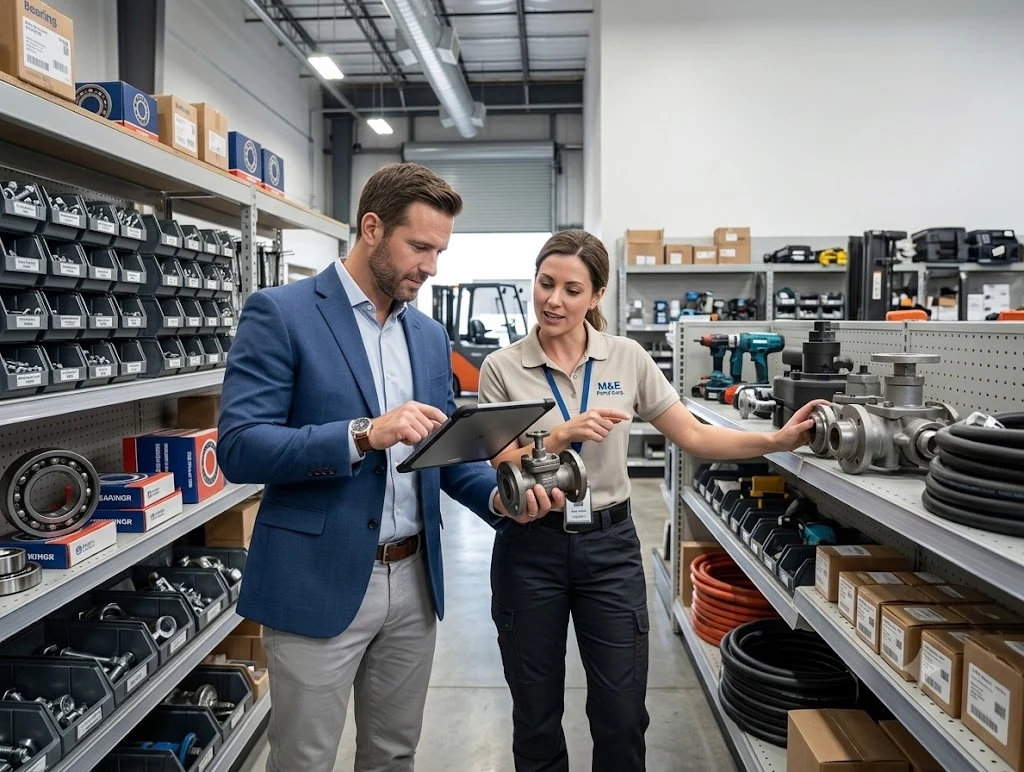
How Manufacturing and Engineering Distributors Can Balance Self-Service Procurement with High-Touch Customer Support
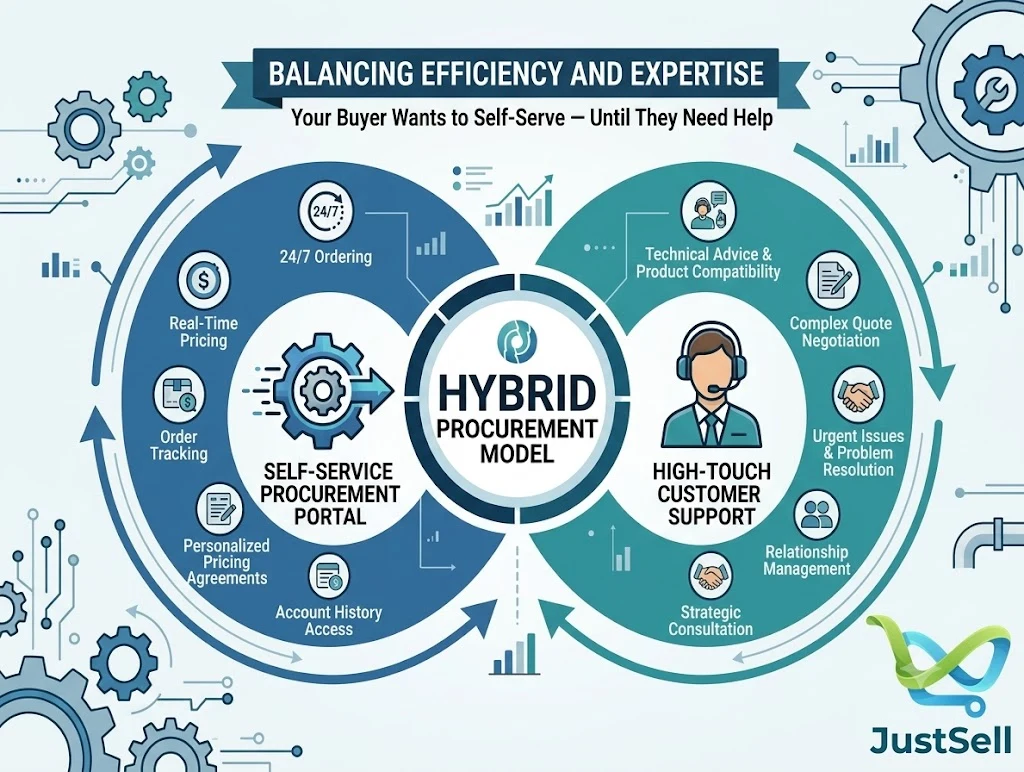
Your Buyer Wants to Self-Serve. Until They Need Help. Your Platform Should Support Both.
For manufacturing and engineering distributors, procurement behaviour is changing quickly.
B2B buyers increasingly expect the same level of convenience they experience in consumer ecommerce: fast ordering, personalised pricing, order history, and self-service account management.
At the same time, these buyers still rely heavily on supplier support when dealing with technical products, complex specifications, urgent requirements, or negotiated pricing agreements.
This creates a hybrid expectation.
Buyers want independence when ordering, but they still expect access to expert support when needed.
If a distributor cannot deliver both, customers often switch to suppliers who offer a smoother digital experience combined with reliable account support.
As digital B2B procurement becomes the standard across industrial supply chains, distributors need platforms that combine self-service functionality with strong customer relationship management.
Synopsis
Engineering buyers want to self-serve until they hit a technical question, and then they want a person. This guide covers what poor digital procurement costs, how portals improve efficiency, and why hybrid models pair self-service with human support.
Table of Contents
- 1.Key Takeaways
- 2.Why B2B Procurement Expectations Are Changing
- 3.The Rise of Self-Service in Manufacturing Distribution
- 4.Why Buyers Still Need Human Support
- 5.The Cost of Poor Digital Procurement Experiences
- 6.Why Traditional B2B Systems Fall Short
- 7.How Self-Service Portals Improve Procurement Efficiency
- 8.Using Account History to Improve Customer Experience
- 9.Why Personalisation Increases Buyer Retention
- 10.How Digital Tools Still Support Human Sales Teams
- 11.Why Hybrid Procurement Models Are the Future
- 12.How JustSell Helps Distributors Deliver Self-Service and Support Together
- 13.FAQ
- 14.Conclusion
- 15.See How JustSell Can Help Your Manufacturing Distribution Business
Key Takeaways
- B2B buyers increasingly expect self-service procurement tools.
- Many buyers still require support for technical and account-based decisions.
- Poor digital experiences can lead to supplier switching.
- Self-service portals improve speed, efficiency and satisfaction.
- Account history and personalisation improve repeat purchasing.
- Hybrid systems combining digital tools and sales support are most effective.
- JustSell enables both self-service procurement and rep-supported workflows.
Why B2B Procurement Expectations Are Changing
Modern B2B buyers are influenced by consumer-grade digital experiences.
They expect:
- Fast ordering
- Real-time pricing
- Order tracking
- Personalised recommendations
- Easy reordering
- Instant access to account information
In manufacturing and engineering distribution, these expectations are becoming standard rather than optional.
Buyers increasingly prefer suppliers that reduce friction in the purchasing process.
The Rise of Self-Service in Manufacturing Distribution
Self-service procurement allows buyers to independently:
- Browse products
- Check pricing
- View stock availability
- Place orders
- Reorder previous purchases
- Download invoices
This reduces reliance on sales teams for routine tasks.
Benefits include:
- Faster purchasing cycles
- Reduced administrative workload
- Improved customer satisfaction
- 24/7 ordering capability
- Greater procurement efficiency
For distributors, self-service systems also reduce operational pressure on internal teams.
Why Buyers Still Need Human Support
Despite the rise of digital procurement, human support remains essential in many situations.
Buyers often need assistance with:
- Technical product selection
- Compatibility checks
- Negotiated pricing
- Large or complex orders
- Urgent procurement issues
- Account-specific queries
In these cases, direct access to sales representatives or account managers is critical.
The most effective systems do not replace human support — they complement it.
The Cost of Poor Digital Procurement Experiences
When self-service systems are poorly implemented or incomplete, buyers often experience friction.
Common Business Impacts
Lost Customers
Buyers switch to suppliers with better digital platforms.
Increased Support Requests
Customers rely heavily on sales teams for basic tasks.
Slower Ordering Processes
Lack of self-service tools creates unnecessary delays.
Reduced Customer Satisfaction
Buyers expect modern, efficient procurement systems.
Lower Repeat Purchase Rates
Poor experiences reduce long-term loyalty.
In competitive industrial markets, these issues can directly impact revenue and retention.
Why Traditional B2B Systems Fall Short
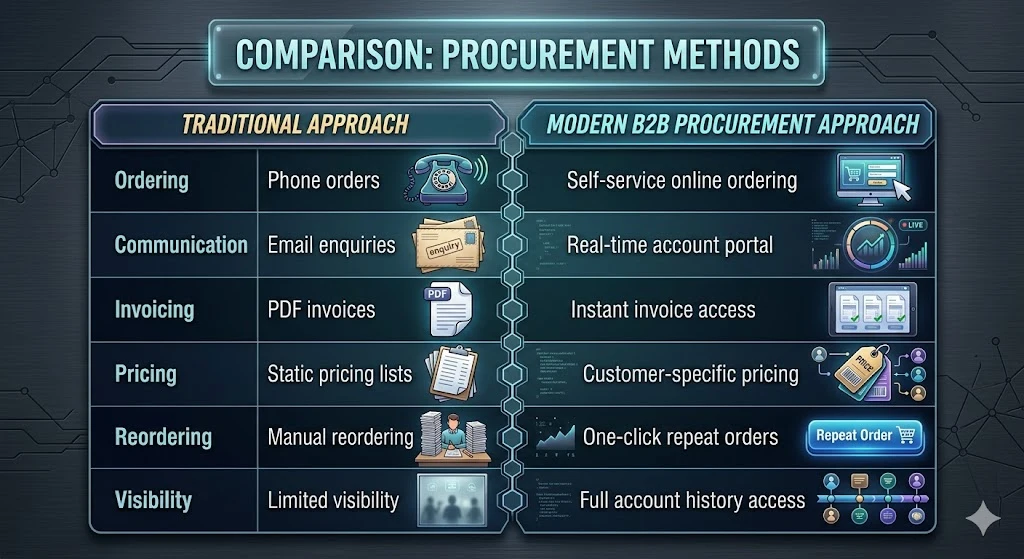
Many distributors still rely on outdated systems such as:
- Email-based ordering
- PDF catalogues
- Phone-based account management
- Static price lists
- Manual invoice requests
- Spreadsheet-based account tracking
While these tools may support basic operations, they do not meet modern buyer expectations.
Traditional vs Modern Procurement Experience
Modern wholesale ecommerce platforms bridge this gap by combining automation with account intelligence.
How Self-Service Portals Improve Procurement Efficiency
Self-service customer portals allow buyers to manage their accounts independently.
Key features include:
- Product browsing
- Real-time pricing
- Stock visibility
- Order placement
- Order tracking
- Invoice access
- Repeat ordering
Benefits include:
- Faster procurement decisions
- Reduced reliance on sales teams
- Improved operational efficiency
- Better customer experience
- Increased order frequency
When buyers can self-serve, procurement becomes significantly more efficient.
Using Account History to Improve Customer Experience
Account history is a critical part of modern B2B procurement.
Buyers often need to:
- Reorder previous items
- Track spending
- Review past invoices
- Check product usage history
- Manage ongoing supply requirements
Access to this data allows customers to make faster and more accurate purchasing decisions.
Benefits include:
- Faster repeat ordering
- Improved procurement accuracy
- Reduced administrative effort
- Better customer relationships
- Increased loyalty
Why Personalisation Increases Buyer Retention
B2B buyers expect personalised experiences based on their account type, pricing agreements, and purchasing behaviour.
Personalisation may include:
- Customer-specific pricing
- Tailored product catalogues
- Contract-based discounts
- Recommended products
- Account-specific terms
Benefits include:
- Higher customer satisfaction
- Increased repeat purchases
- Improved engagement
- Stronger supplier relationships
- Reduced churn
Personalisation helps make procurement feel simpler and more relevant.
How Digital Tools Still Support Human Sales Teams
Self-service systems do not replace sales teams — they enhance them.
Sales representatives can focus on:
- Complex account management
- Upselling and cross-selling
- Technical consultation
- Relationship building
- Strategic accounts
Meanwhile, routine tasks such as ordering, reordering, and invoice retrieval are handled digitally.
This creates a more efficient division of labour across the business.
Why Hybrid Procurement Models Are the Future
The most effective procurement systems combine:
- Digital self-service tools
- Human account support
- Real-time data access
- Personalised pricing
- Flexible ordering options
This hybrid model ensures buyers get speed when they want it and support when they need it.
It also allows distributors to scale without losing customer relationships.
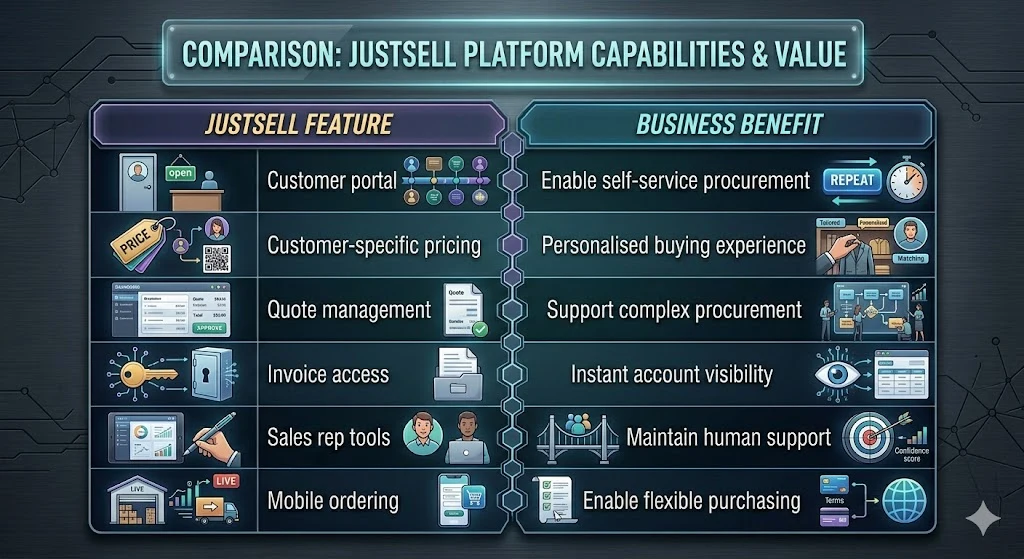
How JustSell Helps Distributors Deliver Self-Service and Support Together
JustSell helps manufacturing and engineering distributors provide a complete procurement experience that combines digital self-service with account-based support.
Key Features
By combining self-service tools with sales support functionality, JustSell helps distributors meet modern buyer expectations without losing the human element.
FAQ
B2B buyers want faster ordering, real-time pricing, and easier access to account information without relying on sales teams for routine tasks.
They often require help with technical product selection, pricing agreements, compatibility checks, and complex orders.
A customer portal is an online platform where buyers can manage orders, view pricing, access invoices, and reorder products.
It reduces reliance on manual processes and allows buyers to place orders and manage accounts instantly.
Personalisation ensures buyers see relevant pricing, products, and account information tailored to their needs.
It automates routine tasks, allowing sales teams to focus on higher-value activities like account growth and customer relationships.
Conclusion
Modern B2B procurement in manufacturing and engineering distribution is no longer purely digital or purely manual — it is both.
Buyers expect the speed and convenience of self-service tools, but they still rely on expert support for complex purchasing decisions.
Distributors that fail to provide this balance risk losing customers to competitors with more advanced digital experiences.
The most successful businesses are those that combine self-service procurement with strong account management and personalised support.
JustSell Wholesale Ecommerce helps distributors achieve this balance by providing customer portals, account history, real-time pricing, sales rep tools, and integrated support functionality in one platform.
See How JustSell Can Help Your Manufacturing Distribution Business
JustSell Wholesale Ecommerce provides:
- Customer portal for self-service ordering
- Account history and repeat ordering
- Customer-specific pricing
- Quote and invoice management
- Sales rep support tools
- Real-time product data
- Mobile ordering access, our Customer Ordering App
- Personalised procurement experience
Book a demo today to see how JustSell can help improve procurement efficiency, enhance customer experience, and support long-term growth.
Related Articles
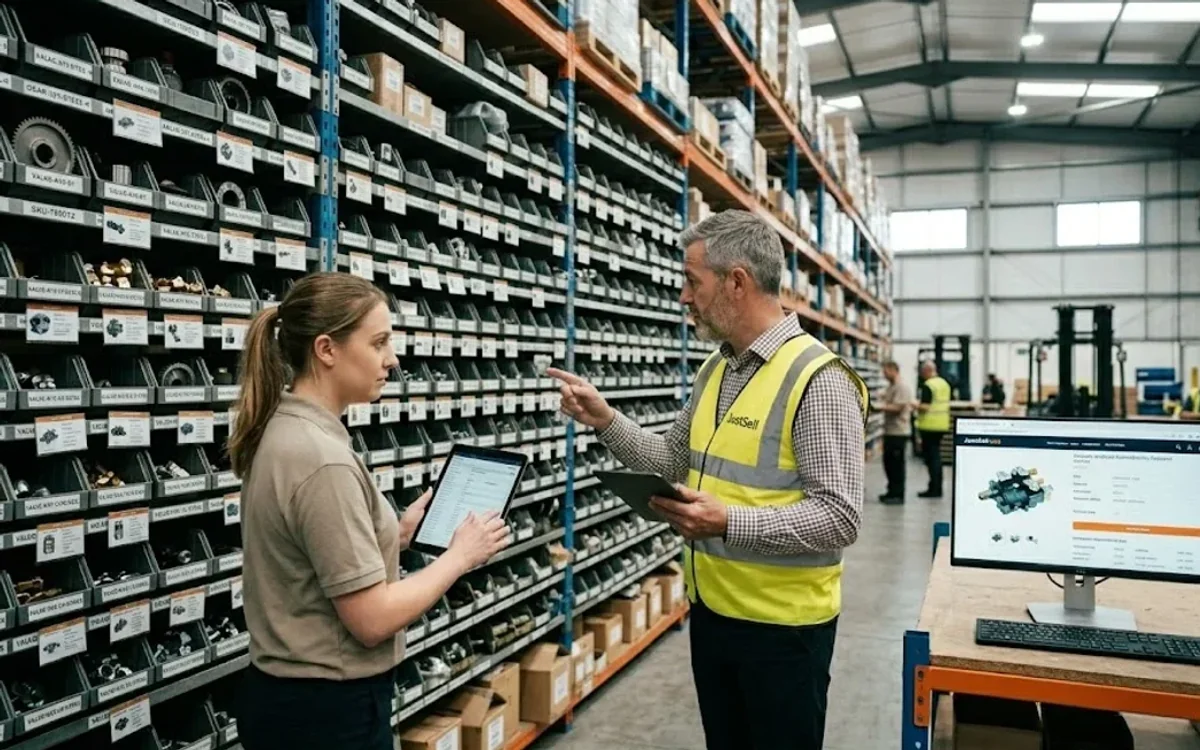
How Manufacturing and Engineering Distributors Can Manage Complex Product Catalogues More Effectively
Engineering catalogues run to tens of thousands of SKUs, each with sizes, materials, ratings and certifications. This guide covers why basic ecommerce falls short, how technical product structures and filtering improve discovery, and where customer-specific catalogues help.
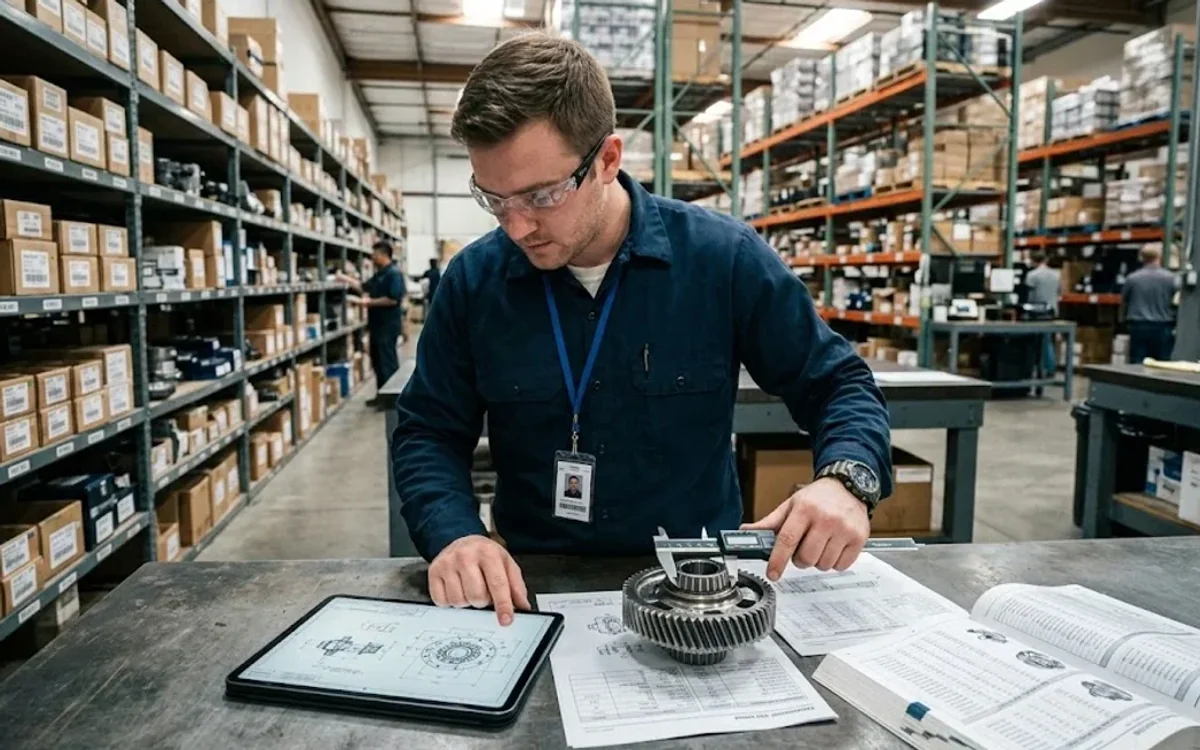
How Manufacturing and Engineering Parts Distributors Can Increase Sales and Improve Customer Ordering with Wholesale Ecommerce
Manufacturing buyers judge a supplier on how easy it is to order, not only on price. This guide covers the cost of manual ordering, how self-service and customer-specific pricing increase sales, and why faster reordering drives repeat business.

How Manufacturing and Engineering Distributors Can Reduce Delays Caused by Quotes and Negotiated Pricing
Manufacturing procurement runs on quotes and negotiated pricing, and every approval adds delay. This guide covers what slow quoting costs, how customer-specific pricing cuts manual enquiries, and how quote-to-order workflows let buyers purchase faster.